
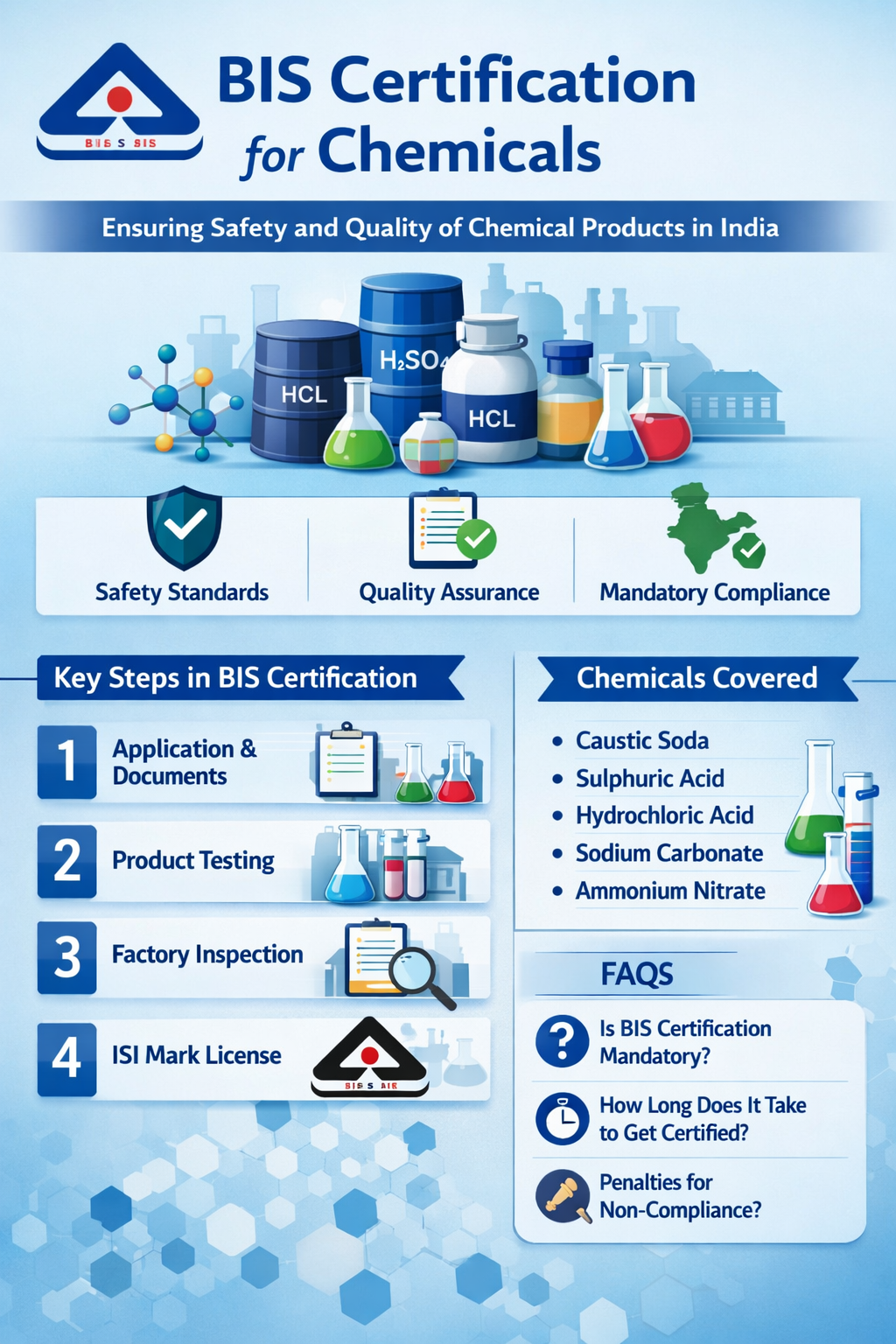
BIS Certification for Chemicals
BIS Certification for Chemicals is a mandatory regulatory requirement in India to ensure that chemical products meet prescribed safety, quality, and performance standards. The certification is issued by the Bureau of Indian Standards (BIS), the national standards body of India, operating under the Ministry of Consumer Affairs, Food & Public Distribution.
Chemical products are widely used across industries such as pharmaceuticals, agriculture, construction, textiles, electronics, cosmetics, and manufacturing. Due to their potential impact on human health, safety, and the environment, the Indian government has made BIS certification compulsory for several chemical products before they can be manufactured, imported, sold, or distributed in India.
Obtaining BIS certification not only ensures regulatory compliance but also helps manufacturers and importers build trust, credibility, and market acceptance for their chemical products.
What is BIS Certification?
BIS Certification is a conformity assessment scheme under which BIS grants a license to manufacturers or importers to use the ISI Mark on their products. The ISI Mark signifies that the product complies with the applicable Indian Standard (IS).
For chemical products, BIS certification verifies:
Chemical composition
Physical and chemical properties
Performance standards
Safety parameters
Environmental compliance
Only BIS-licensed products are legally permitted to enter the Indian market for notified chemical categories.
Why BIS Certification is Important for Chemicals
Chemical products can pose serious risks if they are substandard, contaminated, or improperly formulated. BIS certification ensures that chemicals meet minimum safety and quality benchmarks.
Key Reasons for BIS Certification for Chemicals
Legal Compliance
BIS certification is mandatory for many chemicals under Quality Control Orders (QCOs) issued by the Government of India.Consumer Safety
Ensures chemicals do not pose health hazards to users or the environment.Market Access
BIS-certified chemicals are allowed to be sold, imported, and distributed in India.Quality Assurance
Confirms product consistency, purity, and performance as per Indian Standards.Brand Credibility
ISI-marked products enjoy higher trust among buyers and regulatory authorities.Avoidance of Penalties
Non-compliance may lead to fines, seizure of goods, or legal action.
Types of BIS Certification Applicable to Chemicals
BIS certification for chemicals generally falls under the following schemes:
1. ISI Mark Scheme (Scheme I)
This is the most common certification scheme for chemicals manufactured in India. Under this scheme:
Factory inspection is mandatory
Product samples are tested in BIS-recognized labs
Ongoing surveillance is conducted
2. Foreign Manufacturers Certification Scheme (FMCS)
Applicable to foreign manufacturers exporting chemicals to India.
Key requirements include:
Nomination of Authorized Indian Representative (AIR)
Factory inspection by BIS officials
Product testing in Indian laboratories
Chemicals Covered Under Mandatory BIS Certification
The Indian government has notified several chemical products under mandatory BIS certification through QCOs. Some commonly covered chemicals include:
Caustic Soda
Sulphuric Acid
Hydrochloric Acid
Nitric Acid
Phosphoric Acid
Sodium Carbonate
Sodium Bicarbonate
Ammonium Nitrate
Calcium Carbide
Acetic Acid
Methanol
Industrial Alcohol
Fertilizer-grade chemicals
Dyes and pigments
Polymer and plastic raw materials
The list keeps expanding, so it is important to regularly verify BIS notifications for updated requirements.
Applicable Indian Standards (IS) for Chemicals
Each chemical product has a specific Indian Standard (IS) that defines quality and safety parameters. Examples include:
IS 252: Sulphuric Acid
IS 266: Sodium Carbonate
IS 376: Hydrochloric Acid
IS 264: Nitric Acid
IS 383: Acetic Acid
IS 1735: Caustic Soda
Manufacturers and importers must ensure their products strictly conform to the relevant Indian Standard.
BIS Certification Process for Chemicals
The BIS certification process for chemicals involves multiple technical and regulatory steps.
Step 1: Identification of Applicable Standard
Determine whether the chemical product falls under mandatory BIS certification and identify the relevant Indian Standard.
Step 2: Application Submission
Submit the BIS application along with:
Application form
Manufacturing process details
Quality control plan
Test reports (if available)
Factory layout
Raw material details
Step 3: Product Testing
Samples of the chemical product are tested in a BIS-recognized laboratory as per the applicable Indian Standard.
Step 4: Factory Inspection
BIS officials conduct a factory inspection to verify:
Manufacturing capability
Quality control systems
In-house testing facilities
Storage and handling practices
Step 5: Grant of License
If the product and factory comply with BIS requirements, BIS grants the license to use the ISI Mark on the chemical product.
Step 6: Surveillance and Renewal
Post-certification surveillance audits are conducted periodically, and the license must be renewed before expiry.
Documents Required for BIS Certification for Chemicals
The documentation requirements may vary based on product type and manufacturing location. Generally, the following documents are required:
BIS application form
Certificate of incorporation
Manufacturing license
Factory address proof
Upgrading in-house testing facilities
Handling hazardous material regulations
List of machinery and equipment
Raw material specifications
In-house testing facility details
Test reports from BIS-recognized labs
Quality manual and SOPs
Authorized signatory documents
Nomination of AIR (for foreign manufacturers)
Timeline for BIS Certification for Chemicals
The average timeline for BIS certification depends on product complexity and preparedness:
Indian Manufacturers: 30–90 days
Foreign Manufacturers (FMCS): 3–6 months
Delays may occur due to incomplete documentation, failed test reports, or factory non-compliance.
Cost of BIS Certification for Chemicals
The cost varies based on:
Type of chemical
Number of test parameters
Laboratory testing fees
BIS application and license fees
Consultancy charges (if applicable)
Indicative cost range:
?50,000 to ?2,00,000+ (Indian manufacturers)
Higher for foreign manufacturers due to inspection and travel costs
Common Challenges in BIS Certification for Chemicals
Identifying correct Indian Standards
Meeting stringent purity requirements
Coordination with BIS laboratories
Delays in factory inspection scheduling
Professional consultancy can significantly reduce errors and delays.
Penalties for Non-Compliance
Selling or importing non-BIS-certified chemicals covered under mandatory certification can result in:
Heavy fines
Product seizure
Cancellation of import consignments
Legal prosecution
Business license suspension
Role of BIS Consultant for Chemical Certification
A BIS consultant helps manufacturers and importers by:
Identifying applicable standards
Preparing complete documentation
Coordinating product testing
Managing factory inspections
Liaising with BIS authorities
Ensuring faster certification approval
Engaging an experienced BIS consultant minimizes compliance risks and speeds up the certification process.
BIS Certification for Imported Chemicals
Imported chemicals under mandatory BIS certification must comply before customs clearance. Importers must:
Ensure foreign manufacturer has BIS license under FMCS
Appoint Authorized Indian Representative (AIR)
Mark ISI logo on packaging
Provide BIS license details at customs
Non-compliant imports are rejected or destroyed by authorities.
Benefits of BIS Certification for Chemical Manufacturers
Legal approval to sell in India
Enhanced product acceptance
Improved quality management
Competitive advantage
Access to government and PSU tenders
Reduced regulatory risk
Conclusion
BIS Certification for Chemicals is a critical compliance requirement for manufacturers and importers aiming to operate legally in the Indian market. With increasing government focus on quality, safety, and environmental protection, BIS certification has become indispensable for chemical products.
Understanding applicable standards, following correct procedures, and maintaining consistent quality are key to successful certification. Partnering with an experienced BIS consultancy can simplify the process and ensure timely approval.
Frequently Asked Questions (FAQs) – BIS Certification for Chemicals
1. Is BIS certification mandatory for all chemical products in India?
No, BIS certification is mandatory only for chemicals notified under Quality Control Orders (QCOs) issued by the Government of India. However, the list of mandatory chemicals is expanding regularly, so manufacturers and importers should verify current BIS notifications.
2. Who issues BIS certification for chemicals in India?
BIS certification is issued by the Bureau of Indian Standards (BIS), the national standards body of India under the Ministry of Consumer Affairs, Food & Public Distribution.
3. What is the ISI Mark on chemical products?
The ISI Mark indicates that a chemical product complies with the relevant Indian Standard (IS) and has been certified by BIS for quality, safety, and performance.
4. Can imported chemicals be sold in India without BIS certification?
No. If a chemical product falls under mandatory BIS certification, it cannot be imported, sold, or distributed in India without a valid BIS license under the Foreign Manufacturers Certification Scheme (FMCS).
5. How long does it take to get BIS certification for chemicals?
The timeline depends on product type and readiness:
Indian manufacturers: 30 to 90 days
Foreign manufacturers: 3 to 6 months
Delays may occur due to testing failures or incomplete documentation.
6. What are the main documents required for BIS certification of chemicals?
Key documents include:
BIS application form
Manufacturing license
Factory layout and process flow
Raw material details
Test reports from BIS-recognized labs
Quality control and testing procedures
Additional documents may be required depending on the chemical type.
7. Is factory inspection mandatory for BIS certification?
Yes. BIS conducts a factory inspection to verify manufacturing capability, quality control systems, and in-house testing facilities before granting certification.
8. What happens if a chemical product fails BIS testing?
If a product fails laboratory testing:
The application is kept on hold
Corrective actions must be taken
Fresh samples must be submitted for re-testing
Certification is granted only after full compliance.
9. What is the validity of BIS certification for chemicals?
BIS licenses are usually granted for 1 to 2 years and must be renewed before expiry to continue using the ISI Mark.
10. What are the penalties for selling non-BIS-certified chemicals?
Penalties may include:
Monetary fines
Seizure of products
Cancellation of imports
Legal action under BIS Act
Non-compliance can severely impact business operations.
11. Do small manufacturers also need BIS certification?
Yes. Company size does not matter. If the chemical product falls under mandatory BIS certification, even small and medium manufacturers must obtain certification.
12. Can BIS certification be obtained without a consultant?
Yes, but the process is highly technical and documentation-intensive. Hiring a BIS consultant helps reduce errors, delays, and rejection risks.
13. Is BIS certification required for export-only chemical products?
No, BIS certification is generally not mandatory for export-only products, unless they are also sold in the Indian domestic market or specifically notified by authorities.
14. Can one BIS license cover multiple chemical products?
No. Each chemical product and Indian Standard requires a separate BIS license, even if manufactured in the same facility.
15. How can Fusion Compliance Services help with BIS certification for chemicals?
Fusion Compliance Services provides end-to-end BIS consultancy, including:
Identification of applicable standards
Documentation and application filing
Product testing coordination
Factory inspection support
Fast-track approval and renewal assistance
Representative Client's