
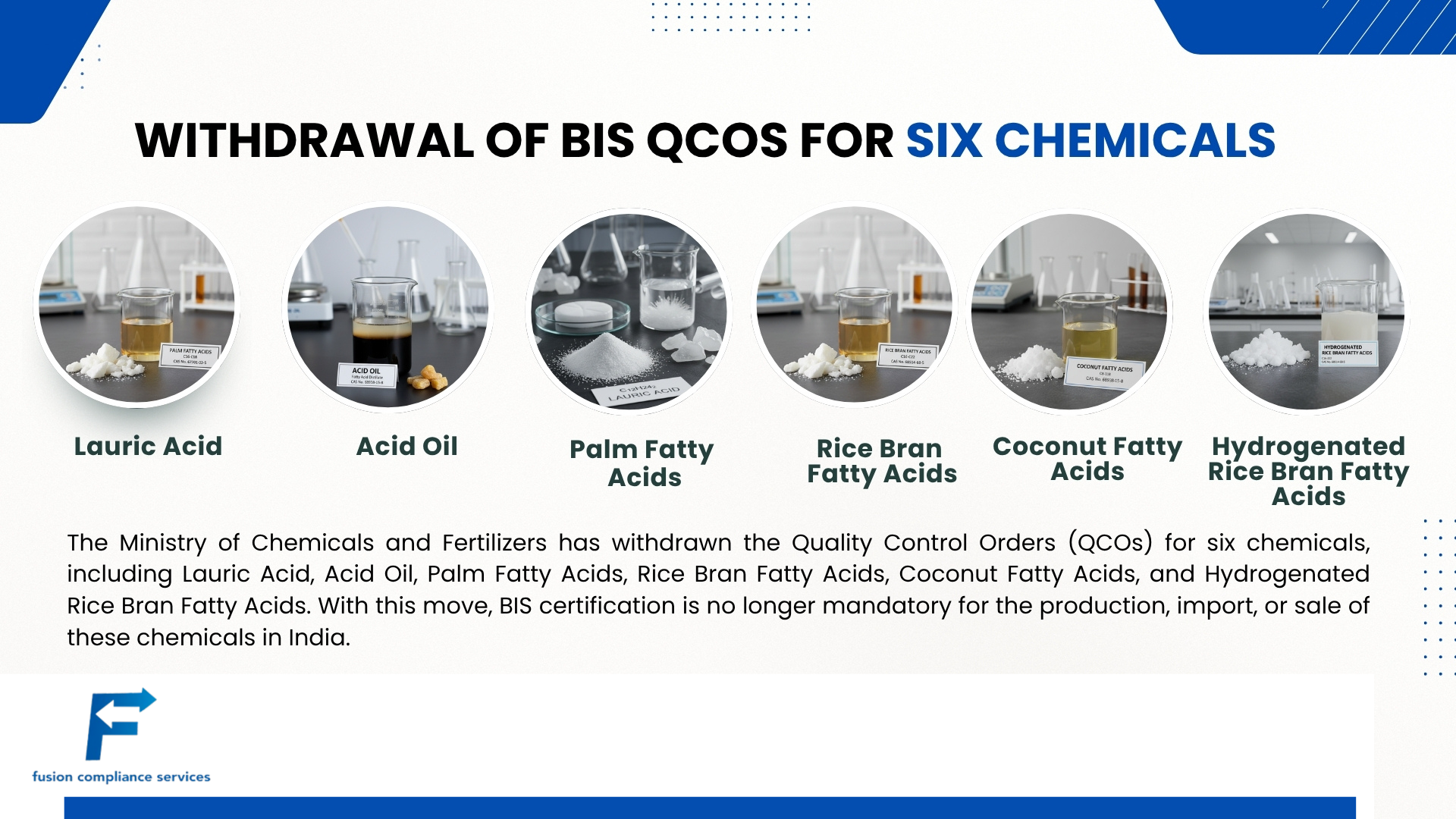
Withdrawal of Quality Control Orders for Six Chemicals – No Longer Under Mandatory BIS Certification
The Government of India has recently withdrawn the Quality Control Orders (QCOs) for six major chemicals, making them no longer subject to mandatory BIS (Bureau of Indian Standards) certification. This decision has brought significant relief to manufacturers, importers, and downstream industries that rely on these chemicals for various industrial and commercial applications. The withdrawal has created a more flexible regulatory environment, encouraging smoother trade, reducing compliance burdens, and supporting the ease of doing business in India.
What Were Quality Control Orders (QCOs)?
Quality Control Orders are regulatory mandates issued by the Ministry of Chemicals and Fertilizers or other related ministries, requiring certain products to be certified by BIS. Once a product falls under a QCO, businesses must obtain BIS certification to manufacture, store, sell, export, or import the product in the Indian market.
These QCOs uphold safety, quality, and environmental standards. However, in some cases, industries raise concerns that certain products under QCOs may disrupt supply chains, increase costs, or pose operational challenges.
Government Decision: Withdrawal of QCOs for Six Chemicals
The recent withdrawal of QCOs for six specific chemicals indicates a strategic shift in regulatory planning. The decision was taken after assessing industry feedback, supply-chain dependencies, global trade conditions, and the overall compliance burden on businesses.
Although the detailed list of chemicals may vary based on official notifications, the general impact remains consistent across sectors: these chemicals no longer require mandatory BIS certification for manufacturing or import.
This withdrawal aims to strike a balance between quality regulation and business facilitation, ensuring industries have easier access to essential raw materials without unnecessary delays or compliance hurdles.
Why Were These QCOs Withdrawn?
The withdrawal of mandatory BIS certification for these chemicals is driven by several key reasons:
1. Industry Challenges and Supply Chain Constraints
Many industries using these chemicals depend on global suppliers. Strict BIS certification often restricts imports, causing raw material shortages. By withdrawing QCOs, the government ensures uninterrupted supply, particularly for MSMEs.
2. Limited Testing Infrastructure
In many cases, the BIS-approved labs for certain chemicals were inadequate in number, leading to delays in testing and certification. The withdrawal eliminates these bottlenecks and streamlines procurement.
3. Encourage Ease of Doing Business
The government is consistently working toward simplifying compliance processes. Removing certain chemicals from the mandatory list directly supports India’s ease-of-doing-business ecosystem.
4. Harmonization with Global Standards
For commonly traded global chemicals, strict mandatory certification may not always be necessary, especially when aligned with international quality benchmarks. The withdrawal helps harmonize Indian regulations with global norms.
5. Support for Fast-Growing Sectors
Industries such as pharmaceuticals, agrochemicals, polymers, cosmetics, and specialty chemicals depend on these raw materials. Removing certification barriers ensures continuous growth and innovation.
Impact on Industry and Importers
1. Reduction in Compliance Costs
Manufacturers and importers no longer need to bear BIS application fees, testing charges, factory inspections, and renewal costs. This directly improves profit margins and reduces operational expenses.
2. Faster Imports and Manufacturing
Without certification requirements, businesses gain faster turnaround times. Import consignments will clear customs more smoothly, helping avoid delays and demurrage charges.
3. Greater Availability of Raw Materials
Market availability improves significantly, preventing shortages and stabilizing prices.
4. Boost to MSMEs and Small Manufacturers
Small-scale manufacturers who previously struggled with BIS procedures now gain relief. They can access materials quickly and focus on production rather than regulatory paperwork.
5. Encouragement of Global Trade Partnerships
International suppliers who earlier avoided India due to complex compliance can now re-engage, ensuring healthier competition and better pricing.
What Businesses Should Do Next
Even though BIS certification is no longer mandatory for these six chemicals, businesses must still ensure that the products they procure meet quality and safety standards. Here’s what companies should continue doing:
Source chemicals from trusted and compliant suppliers
Maintain in-house quality control systems
Stay updated with future regulatory notifications
Ensure their finished products meet all relevant Indian and global standards
The withdrawal does not imply a lack of quality oversight—it simply removes mandatory certification. Companies remain responsible for adhering to quality, safety, and environmental norms.
Role of Compliance Consultants After Withdrawal
Although mandatory BIS certification is no longer applicable, regulatory consultants continue to play a crucial role in:
Updating companies on policy changes
Ensuring compliance with remaining regulations
Guiding on voluntary certifications (if beneficial)
Assisting with documentation, import regulations, and standards interpretation
Businesses should continue engaging compliance experts to navigate the evolving regulatory landscape.
Conclusion
The withdrawal of Quality Control Orders for six chemicals is an important regulatory development aimed at supporting trade, reducing compliance burdens, and fostering business-friendly operations in India. This change is expected to significantly benefit manufacturers, importers, and industries reliant on chemical raw materials. As India continues to refine its regulatory frameworks, such decisions reflect a balanced approach toward safety, quality, and economic growth.
Representative Client's