
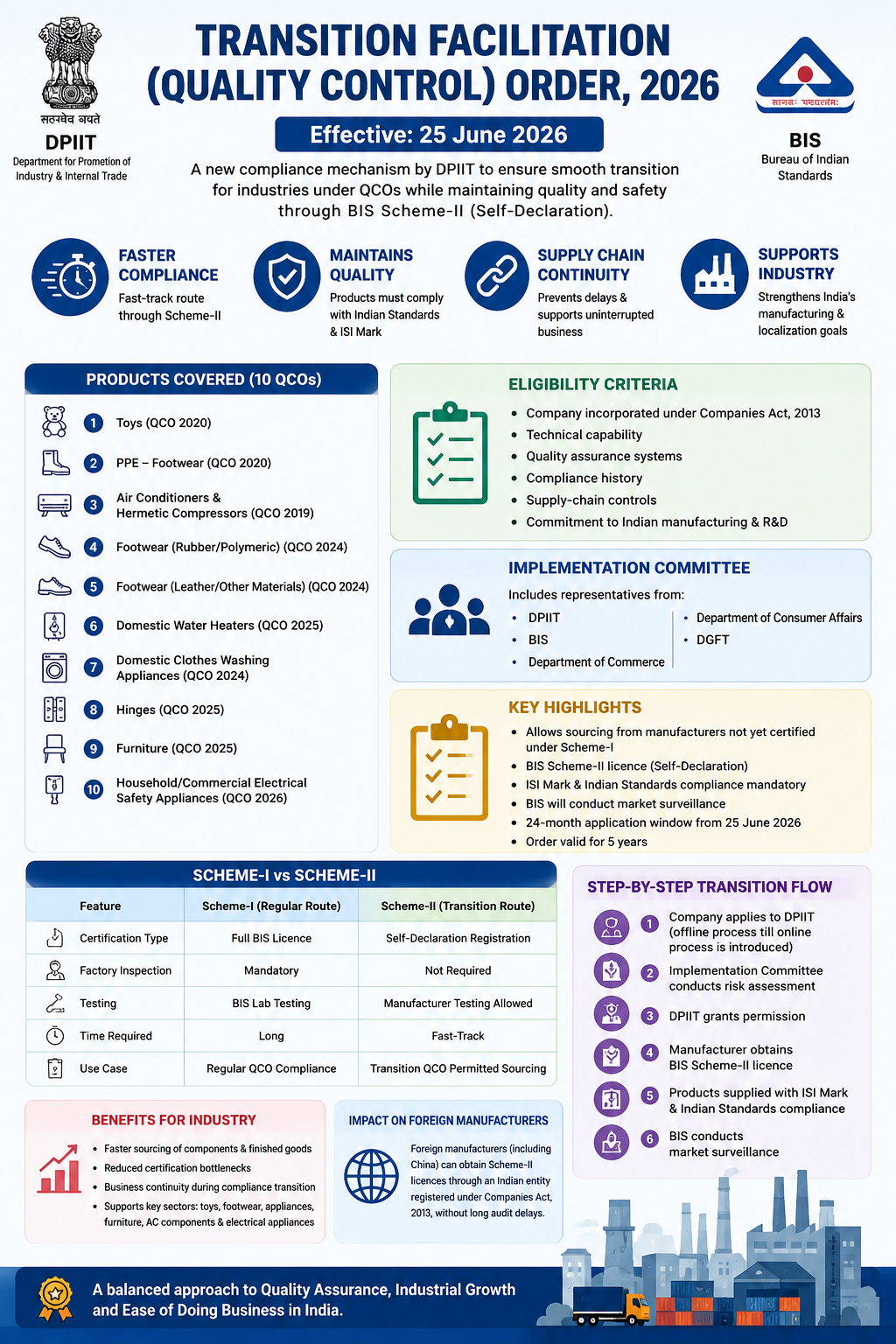
Transition Facilitation (Quality Control) Order, 2026 – Complete Guide
The Transition Facilitation (Quality Control) Order, 2026 is a significant initiative introduced by the Department for Promotion of Industry and Internal Trade (DPIIT) in collaboration with the Bureau of Indian Standards (BIS). Effective from 25 June 2026, this order aims to simplify compliance for manufacturers and importers affected by various Quality Control Orders (QCOs) while maintaining product quality and consumer safety. The order introduces a temporary compliance framework that helps industries continue manufacturing and sourcing products without major disruptions during the transition to mandatory BIS certification.
Why Was the Transition Facilitation Order Introduced?
Over the past few years, the Government of India has expanded the scope of Quality Control Orders (QCOs) across multiple industries to ensure that products sold in the Indian market meet prescribed Indian Standards. While these regulations have improved product quality, many manufacturers experienced delays in obtaining BIS Scheme-I certification, particularly due to factory inspection requirements and certification backlogs.
These delays resulted in supply chain disruptions, production challenges, and increased compliance costs for manufacturers and importers. To address these concerns, DPIIT introduced the Transition Facilitation (Quality Control) Order, 2026, creating a practical pathway for eligible businesses to continue operations while completing the certification process.
What is the Transition Facilitation Order?
The Transition Facilitation Order is a temporary compliance mechanism that allows eligible companies to source products from manufacturers who have not yet obtained full BIS Scheme-I certification. Instead, such manufacturers may obtain a BIS Scheme-II licence, which is based on self-declaration and does not require mandatory factory inspections.
Although the certification process becomes faster, manufacturers must still ensure that products conform to the relevant Indian Standards and carry the mandatory ISI Mark. BIS will continue market surveillance to verify compliance and maintain product quality.
Products Covered Under the Order
The Transition Facilitation Order currently applies to products covered under ten major Quality Control Orders, including:
Toys
PPE Footwear
Air Conditioners and Hermetic Compressors
Rubber and Polymeric Footwear
Leather and Other Material Footwear
Domestic Water Heaters
Domestic Clothes Washing Appliances
Hinges
Furniture
Household and Commercial Electrical Safety Appliances
These sectors are among the most affected by certification timelines, making the order particularly beneficial for manufacturers and importers operating in these industries.
Eligibility Criteria
Only companies incorporated under the Companies Act, 2013 are eligible to apply for benefits under the Transition Facilitation Order.
Applications are evaluated by an Implementation Committee, which considers several important factors, including:
Technical capability
Quality assurance systems
Previous compliance history
Supply chain management
Commitment to manufacturing and research in India
This evaluation ensures that only responsible and capable businesses receive permission under the transition framework.
Implementation Committee
The Implementation Committee consists of representatives from several government departments, including:
DPIIT
Bureau of Indian Standards (BIS)
Department of Commerce
Department of Consumer Affairs
Directorate General of Foreign Trade (DGFT)
The committee reviews applications and recommends whether permission should be granted under the Transition Facilitation framework.
How the Permission Process Works
The process begins when an eligible company submits an application to DPIIT. After a detailed assessment by the Implementation Committee, DPIIT grants permission if the applicant satisfies all eligibility conditions.
Once approval is received, the manufacturer can obtain a BIS Scheme-II licence, allowing products to be supplied under the Transition Facilitation framework. Products must still comply with applicable Indian Standards and display the ISI Mark. BIS will continue monitoring products through regular market surveillance to ensure ongoing compliance.
Application Timeline and Validity
The government has provided a 24-month application window, starting from 25 June 2026, during which eligible companies can apply.
The Transition Facilitation Order itself will remain valid for five years, providing industries with sufficient time to transition smoothly toward complete BIS certification requirements. The Scheme-II licence offers a significantly faster certification route compared to the traditional Scheme-I process.
Benefits for Manufacturers and Importers
The Transition Facilitation Order provides several important advantages, including:
Faster sourcing of components and finished products
Reduced certification delays
Improved supply chain continuity
Lower compliance bottlenecks
Support for domestic manufacturing and industrial growth
Easier transition to full BIS compliance
Better business continuity during regulatory changes
Industries such as toys, footwear, electrical appliances, furniture, and air conditioning components are expected to benefit significantly from this initiative.
Impact on Foreign Manufacturers
The order also creates opportunities for foreign manufacturers. Companies located outside India, including those in China and other countries, may obtain BIS Scheme-II licences through an Indian entity registered under the Companies Act, 2013. This reduces the need for lengthy factory audits while ensuring compliance with Indian Standards.
Conclusion
The Transition Facilitation (Quality Control) Order, 2026 represents an important step toward balancing regulatory compliance with ease of doing business. By introducing a fast-track certification pathway through BIS Scheme-II, the government aims to reduce certification bottlenecks, strengthen supply chains, and encourage industrial growth without compromising product quality. Businesses operating in sectors covered by Quality Control Orders should evaluate their eligibility and take advantage of this transition mechanism to ensure uninterrupted operations while progressing toward full BIS compliance.
Representative Client's