
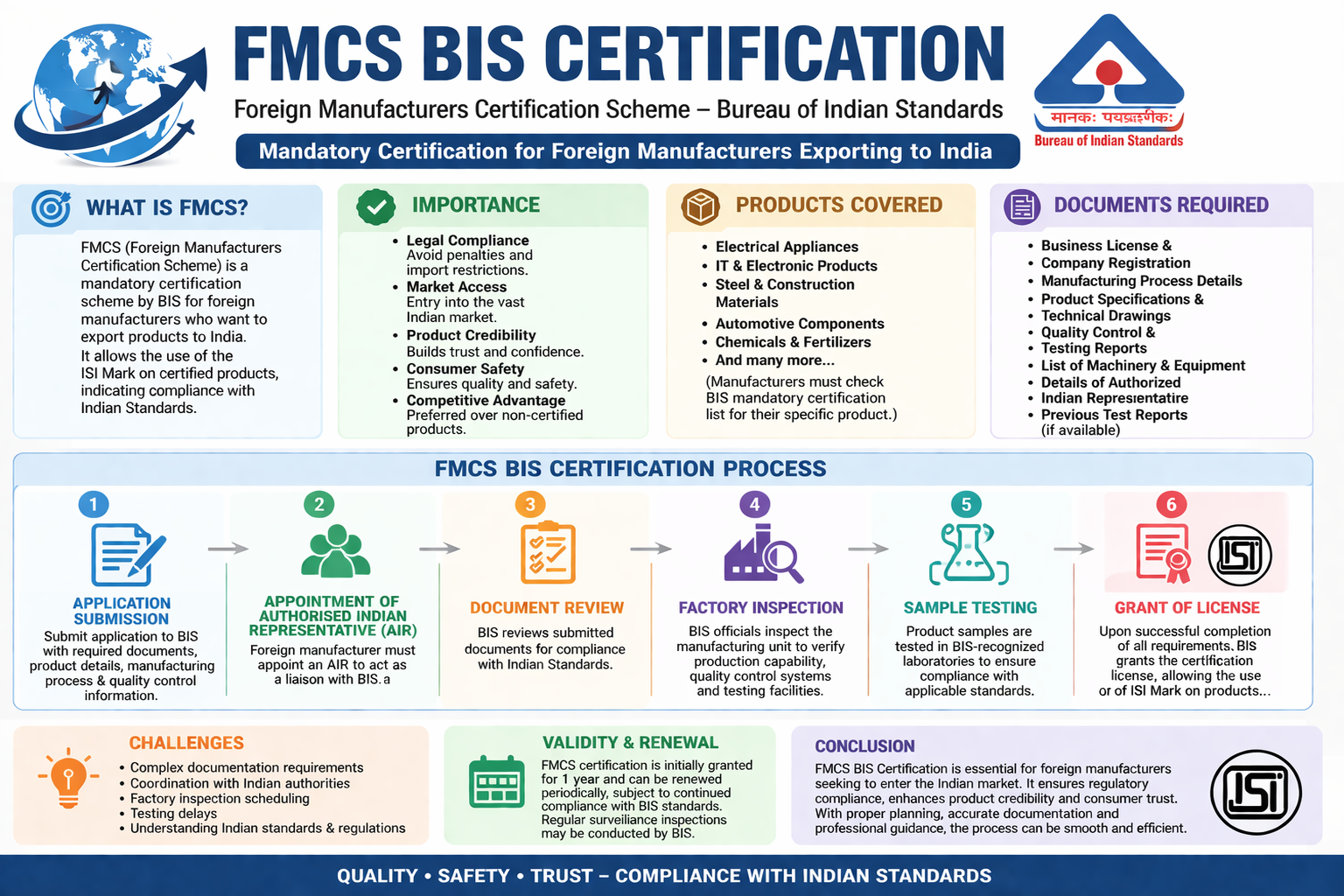
FMCS BIS Certification
The FMCS BIS Certification (Foreign Manufacturers Certification Scheme) is a mandatory certification process governed by the Bureau of Indian Standards (BIS) for foreign manufacturers who wish to export their products to India. Under this scheme, overseas manufacturers must obtain BIS certification before selling products that fall under mandatory Indian standards. This ensures that imported goods meet quality, safety, and reliability requirements as prescribed by Indian regulations.
What is FMCS BIS Certification?
FMCS (Foreign Manufacturers Certification Scheme) is designed specifically for manufacturers located outside India. Unlike domestic manufacturers who apply under the normal BIS certification scheme, foreign entities must follow a structured process to obtain a BIS license under FMCS. Once approved, the manufacturer is authorized to use the Standard Mark (ISI Mark) on their products, indicating compliance with Indian standards.
The certification is applicable to a wide range of products such as electronics, steel products, cement, automotive components, chemicals, and more. Without FMCS certification, these products cannot be legally imported, distributed, or sold in India.
Importance of FMCS BIS Certification
Obtaining FMCS BIS certification offers several benefits:
Legal Compliance: It ensures compliance with Indian regulations, avoiding penalties and import restrictions.
Market Access: Enables foreign manufacturers to enter the vast Indian market.
Product Credibility: Enhances brand trust by demonstrating adherence to quality standards.
Consumer Safety: Guarantees that products meet safety and performance benchmarks.
Competitive Advantage: Certified products are preferred over non-certified alternatives.
Products Covered Under FMCS
BIS has notified various products that require mandatory certification. Some common categories include:
Electrical appliances
IT and electronic products
Steel and construction materials
Automotive components
Chemicals and fertilizers
Manufacturers must check whether their product falls under the mandatory certification list issued by BIS before exporting to India.
FMCS BIS Certification Process
The process for obtaining FMCS certification involves several steps:
Application Submission
The foreign manufacturer submits an application to BIS along with necessary documents, including product details, manufacturing process, and quality control measures.Nomination of Authorized Indian Representative (AIR)
Since the applicant is based outside India, they must appoint an Authorized Indian Representative who will act as a liaison between the manufacturer and BIS.Document Review
BIS evaluates the submitted documents to ensure compliance with relevant Indian Standards.Factory Inspection
BIS officials conduct an on-site inspection of the foreign manufacturing unit to verify production capabilities, quality control systems, and testing facilities.Sample Testing
Product samples are collected and tested in BIS-recognized laboratories to confirm compliance with applicable standards.Grant of License
If all requirements are fulfilled, BIS grants the certification license, allowing the manufacturer to use the ISI mark on their products.
Documents Required
To apply for FMCS BIS certification, manufacturers need to submit:
Business license and company registration documents
Manufacturing process details
Product specifications and technical drawings
Quality control and testing reports
List of machinery and equipment
Details of Authorized Indian Representative
Previous test reports (if available)
Proper documentation is crucial to avoid delays in the approval process.
Validity and Renewal
FMCS BIS certification is initially granted for one year and can be renewed periodically. Manufacturers must ensure continued compliance with BIS standards and maintain consistent product quality. Regular surveillance inspections may be conducted by BIS to ensure ongoing compliance.
Challenges in FMCS Certification
Foreign manufacturers may face certain challenges during the certification process:
Complex documentation requirements
Coordination with Indian authorities
Factory inspection scheduling
Testing delays
Understanding Indian standards and regulations
Working with experienced consultants can help streamline the process and reduce the chances of rejection.
Role of BIS in FMCS
The Bureau of Indian Standards plays a crucial role in maintaining product quality in India. Through FMCS, BIS ensures that imported goods meet the same standards as domestically manufactured products. This creates a level playing field and protects consumers from substandard imports.
Conclusion
FMCS BIS Certification is an essential requirement for foreign manufacturers aiming to enter the Indian market. It not only ensures regulatory compliance but also enhances product credibility and consumer trust. Although the process can be complex, proper planning, accurate documentation, and professional guidance can make it smooth and efficient.
For foreign companies, obtaining FMCS certification is not just a regulatory obligation—it is a strategic step toward building a strong presence in India’s competitive marketplace.
Representative Client's