
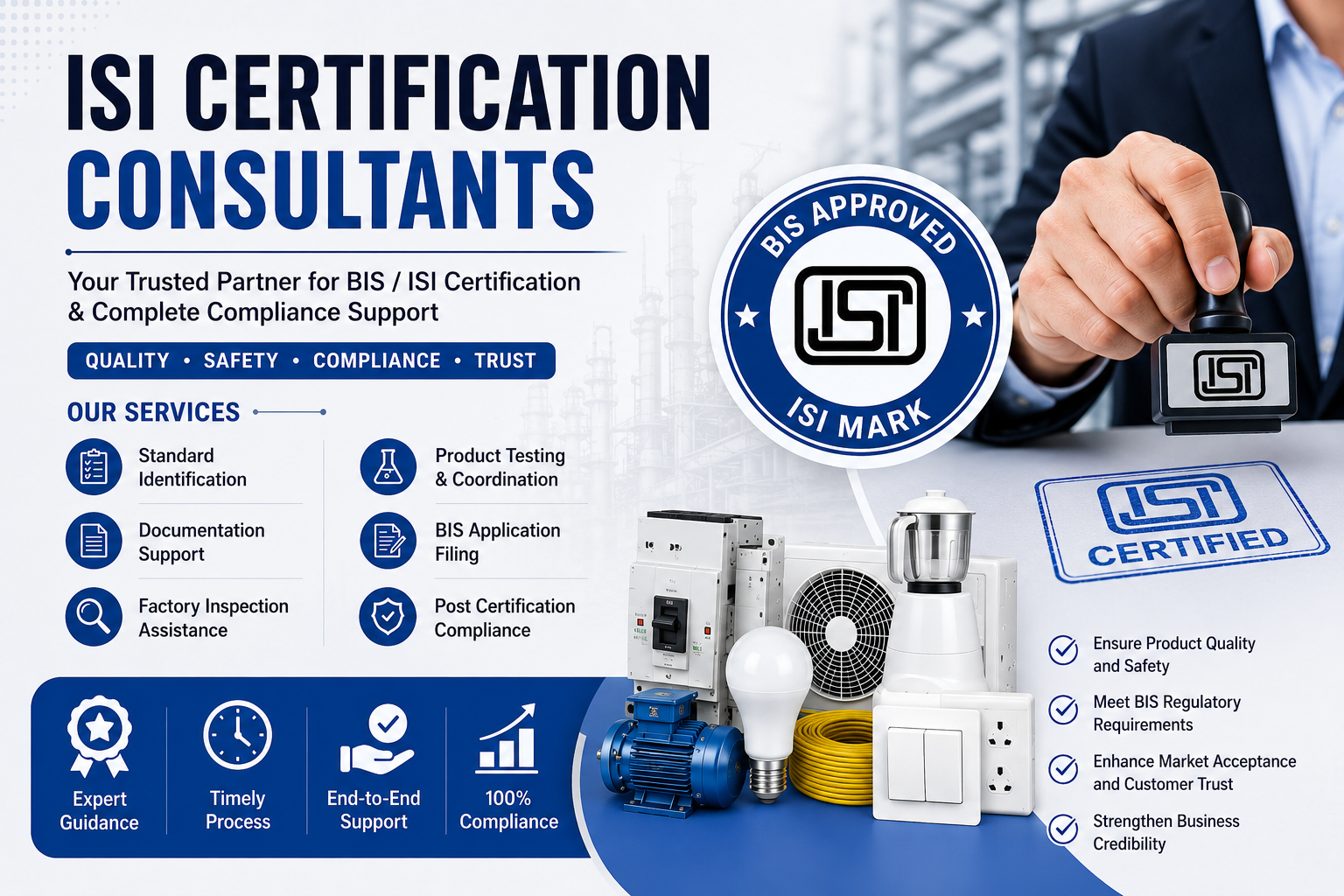
ISI Certification Consultants
ISI certification is an important quality and safety certification for manufacturers who want to sell specified products in the Indian market. The ISI Mark, issued under the Bureau of Indian Standards (BIS) certification framework, demonstrates that a product conforms to the applicable Indian Standard and meets prescribed requirements for quality, safety, performance, and reliability. For businesses dealing with products covered under mandatory certification requirements, obtaining the appropriate BIS licence and using the ISI Mark is essential for lawful market access.
ISI Certification Consultants help manufacturers understand the applicable standards, documentation, testing requirements, application procedures, and BIS compliance obligations. Professional consultancy can make the certification process more organised and reduce the possibility of delays caused by incorrect documents, unsuitable testing, or procedural mistakes.
What is ISI certification?
'ISI Certification' refers to conformity with an applicable Indian Standard and, where certification is mandatory, authorisation from BIS to use the ISI Standard Mark on the certified product. The requirements vary according to the product category and its applicable Indian Standard.
Products such as electrical appliances, construction materials, cement, steel products, automotive components, household goods, and several other regulated products may be subject to BIS requirements. Manufacturers should first identify the correct Indian Standard and applicable certification scheme before beginning the application process.
Role of ISI Certification Consultants
ISI Certification Consultants provide professional assistance throughout the certification journey. Their role generally begins with identifying the applicable product standard and understanding the manufacturer's requirements.
A consultant can assist with:
Identification of the applicable Indian Standard
Product and manufacturing process assessment
Documentation preparation
Selection and coordination with appropriate BIS-recognized laboratories
Sample testing guidance
BIS application preparation
Factory inspection preparation
Corrective action support
Follow-up with the certification process
Licence documentation and compliance guidance
Post-certification compliance support
Having experienced consultants can help manufacturers understand technical and regulatory requirements before submitting their application.
ISI Certification Process
The ISI certification process generally involves several stages. First, the manufacturer needs to identify the applicable Indian Standard for the product. The requirements may include specifications related to raw materials, manufacturing processes, product performance, testing, marking, packaging, and quality control.
After determining the applicable standard, the required technical and manufacturing documents are prepared. Product samples may then need to be tested through an appropriate laboratory according to the applicable requirements.
Once the necessary documentation and test reports are available, the BIS application can be submitted through the applicable procedure. Depending on the certification scheme and product category, BIS may conduct a factory inspection to evaluate manufacturing facilities, quality-control arrangements, testing capabilities, production processes, and compliance with the relevant Indian Standard.
If deficiencies are identified during inspection or evaluation, corrective actions may be required. After successful completion of the evaluation and fulfilment of applicable requirements, BIS may grant the licence subject to the applicable terms and conditions.
Documents Required for ISI Certification
The exact documentation depends on the product and certification requirements. Commonly required documents may include the manufacturer's company details, factory address, product information, manufacturing process details, quality-control information, machinery and testing equipment details, technical specifications, product drawings, raw material information, laboratory test reports, and relevant declarations.
A consultant can help organise these documents and identify missing information before submission, which can make the overall process more efficient.
Benefits of Hiring ISI Certification Consultants
Professional consultancy can provide several advantages to manufacturers. Consultants help businesses understand complicated certification requirements and prepare applications according to the applicable procedures.
Some key benefits include the following:
1. Proper Standard Identification: Consultants help determine the applicable Indian Standard for the product.
2. Documentation Support: They assist in preparing and organizing technical and legal documents.
3. Testing Guidance: Consultants can provide guidance regarding applicable product testing and laboratory requirements.
4. Inspection Preparation: They help manufacturers prepare their factory, quality-control systems, records, and testing facilities for BIS inspection.
5. Reduced Delays: Proper preparation can reduce errors and avoid unnecessary delays caused by incomplete submissions.
6. Compliance Support: Consultants can continue supporting manufacturers with certification-related compliance and renewal requirements.
Why Choose Professional ISI Certification Consultants?
ISI Certification involves technical requirements as well as regulatory procedures. Manufacturers unfamiliar with BIS processes may face difficulties in selecting the correct standard, preparing test samples, maintaining quality-control records, or responding to observations.
Experienced ISI Certification Consultants provide structured support from initial assessment through certification. They can help manufacturers understand their responsibilities and prepare for each stage of the process.
However, consultancy does not replace BIS evaluation. The final decision regarding certification rests with BIS, and manufacturers must independently fulfill all applicable technical and regulatory requirements.
ISI Certification for Manufacturers
Manufacturers planning to introduce regulated products in India should determine whether their product falls under a mandatory BIS certification requirement. Selling products covered by compulsory certification without the required approval can create regulatory and market-access problems.
Obtaining the appropriate certification demonstrates a manufacturer's commitment to quality and compliance. It can also improve customer confidence, strengthen business credibility, and support access to organized retail, institutional procurement, and other business opportunities where compliance documentation may be required.
Conclusion
ISI Certification Consultants play an important role in helping manufacturers navigate the BIS certification process. From identifying the applicable Indian Standard and arranging testing to preparing documentation and supporting factory inspection, professional guidance can make the certification journey more systematic and efficient.
Manufacturers should always verify the latest BIS requirements applicable to their specific product because standards, certification procedures, and regulatory requirements may change. With proper preparation, technical compliance, and professional consultancy support, businesses can work toward obtaining the required ISI certification and maintaining compliance in the Indian market.
Representative Client's