
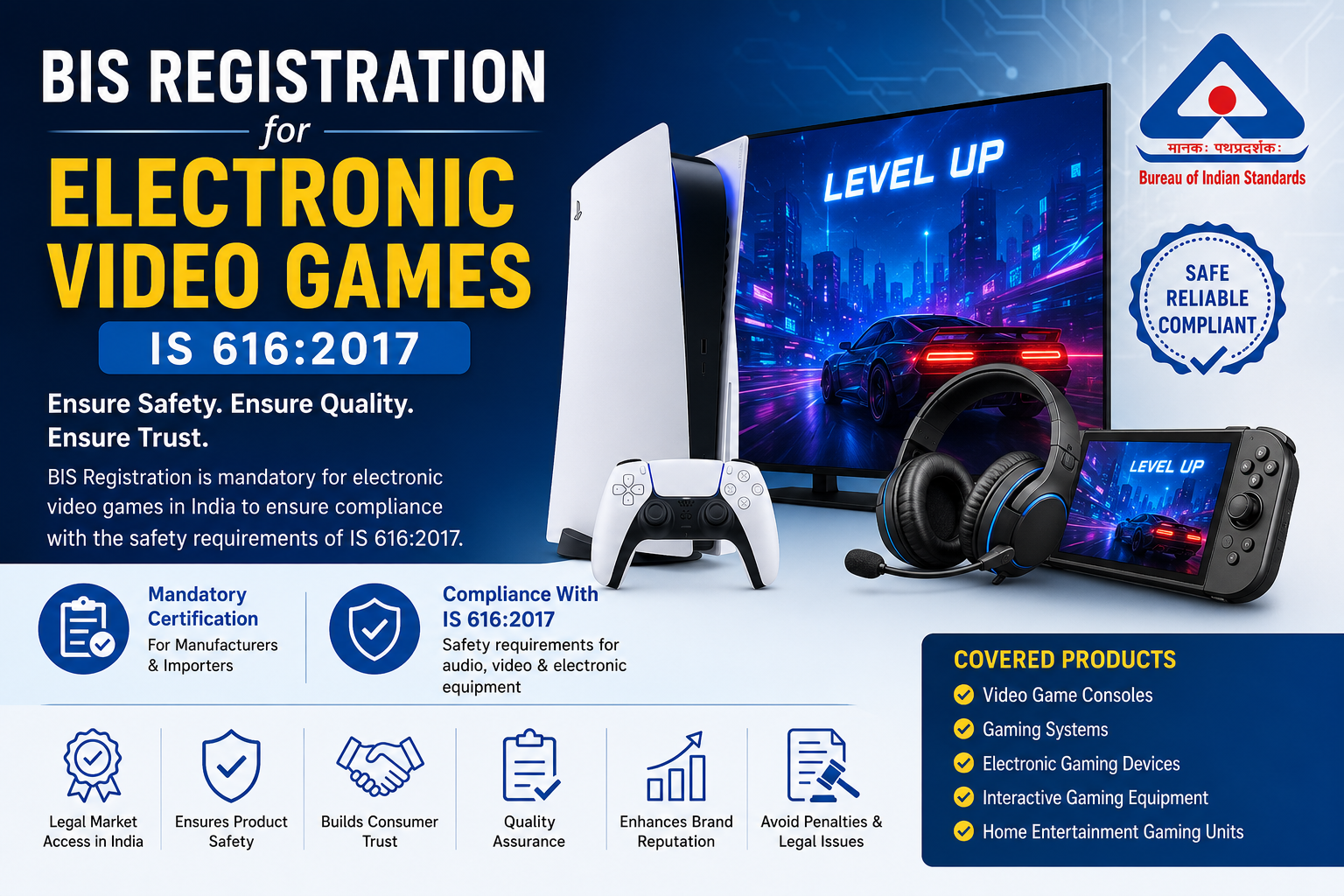
BIS Registration for Electronic Video Games - IS 616:2017
The Bureau of Indian Standards (BIS) has issued new guidelines regarding the migration to IS/IEC 62368-1:2023, following the notification released by the Ministry of Electronics and Information Technology (MeitY). This development is a significant step under the Electronics and Information Technology Goods (Requirement of Compulsory Registration) Order, 2021, which governs the safety and quality requirements for electronic and IT products sold in India.
The introduction of IS/IEC 62368-1:2023 marks a major shift in product safety regulations for audio/video equipment, information technology devices, and communication technology products. Manufacturers, importers, and brand owners operating in the Indian market must understand the migration requirements and timelines to maintain compliance and ensure uninterrupted access to the market.
Background of the New Notification
On 29 October 2025, MeitY issued notification S.O. 4997(E) introducing IS/IEC 62368-1:2023 – Audio/Video, Information and Communication Technology Equipment – Safety Requirements. This updated standard replaces two important Indian safety standards that have been widely used under the BIS Compulsory Registration Scheme (CRS):
- IS 13252 (Part 1):2010 – Safety of Information Technology Equipment
- IS 616:2017 – Safety Requirements for Audio, Video and Similar Electronic Apparatus
The adoption of IS/IEC 62368-1:2023 aligns Indian regulatory requirements with internationally recognized safety standards. It reflects the growing convergence of information technology, communication technology, and multimedia equipment, which often combine multiple functions within a single device.
Concurrent Running Period Until November 2028
To provide manufacturers with sufficient time to adapt to the new requirements, BIS has introduced a concurrent running period up to 01 November 2028.
During this transition period, manufacturers may continue obtaining or maintaining BIS registrations under the existing standards while simultaneously preparing for migration to IS/IEC 62368-1:2023. This approach allows businesses to redesign products, complete testing, and update technical documentation without disrupting production or sales activities.
After 01 November 2028, the old standards will no longer be applicable for the affected product categories, and compliance with IS/IEC 62368-1:2023 will become mandatory under the BIS CRS scheme.
Products Covered Under the Migration
The migration affects a wide range of electronic and IT products currently covered under the BIS Compulsory Registration Scheme. Some of the major product categories include:
- Electronic Video Games
- Laptops and Notebooks
- Tablets
- LCD, LED, and Plasma Televisions
- Visual Display Units (VDUs)
- Video Monitors
- Optical Disc Players with Built-in Amplifiers (200W and Above)
- Printers
- Multi-Function Devices (MFDs)
- Plotters
- Scanners
- Barcode Readers
- USB-driven Fingerprint Scanners
- Iris Scanners
- Wireless Keyboards
- Telephone Answering Machines
- High-Power Amplifiers
- Electronic Musical Systems
Manufacturers and importers dealing with these products must carefully evaluate their existing registrations and begin planning for the transition to avoid future compliance issues.
Importance of IS/IEC 62368-1:2023
One of the most significant features of IS/IEC 62368-1:2023 is its adoption of the Hazard-Based Safety Engineering (HBSE) approach. Unlike traditional safety standards that focus on specific construction requirements, the HBSE methodology identifies potential hazards and establishes safeguards to minimize risks.
This modern approach offers several advantages:
Enhanced Product Safety
The standard provides improved protection against electrical shock, fire hazards, mechanical risks, thermal injuries, and energy-related hazards.
International Harmonization
Since IEC 62368-1 is recognized globally, compliance with the Indian version helps manufacturers meet international market requirements and simplifies global product certification efforts.
Support for Modern Technologies
Today's electronic devices frequently combine audio, video, computing, and communication functions. The new standard is specifically designed to address these converged technologies.
Future-Proof Framework
The hazard-based approach offers greater flexibility to accommodate technological innovations and emerging product categories without requiring constant revisions to the standard.
What Manufacturers Should Do
To ensure timely compliance, manufacturers should start preparing well before the final migration deadline. The following actions are recommended:
Review Existing BIS Registrations
Identify products currently registered under IS 13252 (Part 1):2010 or IS 616:2017 and determine whether they fall within the scope of the migration.
Conduct Product Testing
Arrange testing according to IS/IEC 62368-1:2023 through BIS-recognized laboratories. Early testing can help identify potential compliance gaps.
Update Technical Documentation
Manufacturers should revise technical files, safety assessments, risk analyses, user manuals, and product specifications to meet the new requirements.
Coordinate with BIS Consultants
Working with experienced BIS consultants can simplify the migration process and reduce the chances of delays or non-compliance.
Submit Applications in Advance
Avoid waiting until the last moment. Early submission of migration or new registration applications can help prevent certification bottlenecks closer to the deadline.
Impact on the Electronics Industry
The implementation of IS/IEC 62368-1:2023 represents a major advancement in India's electronics regulatory framework. As consumer electronics become increasingly sophisticated and interconnected, a unified safety standard helps ensure consistent protection across various product categories.
The transition will strengthen consumer confidence, improve product safety, and enhance India's alignment with global regulatory practices. Manufacturers that proactively adopt the new standard will be better positioned to compete in both domestic and international markets.
Conclusion
The BIS guidelines for migration to IS/IEC 62368-1:2023 provide a clear roadmap for manufacturers, importers, and brand owners operating under the Compulsory Registration Scheme. With the concurrent running period extending until 01 November 2028, businesses have adequate time to prepare for the transition from IS 13252 (Part 1):2010 and IS 616:2017.
However, early action is strongly recommended. By initiating testing, updating documentation, and planning compliance activities now, manufacturers can ensure seamless certification, uninterrupted product approvals, and continued access to the Indian market. The adoption of IS/IEC 62368-1:2023 is not only a regulatory requirement but also a step toward safer, more reliable, and globally compliant electronic products.
Representative Client's