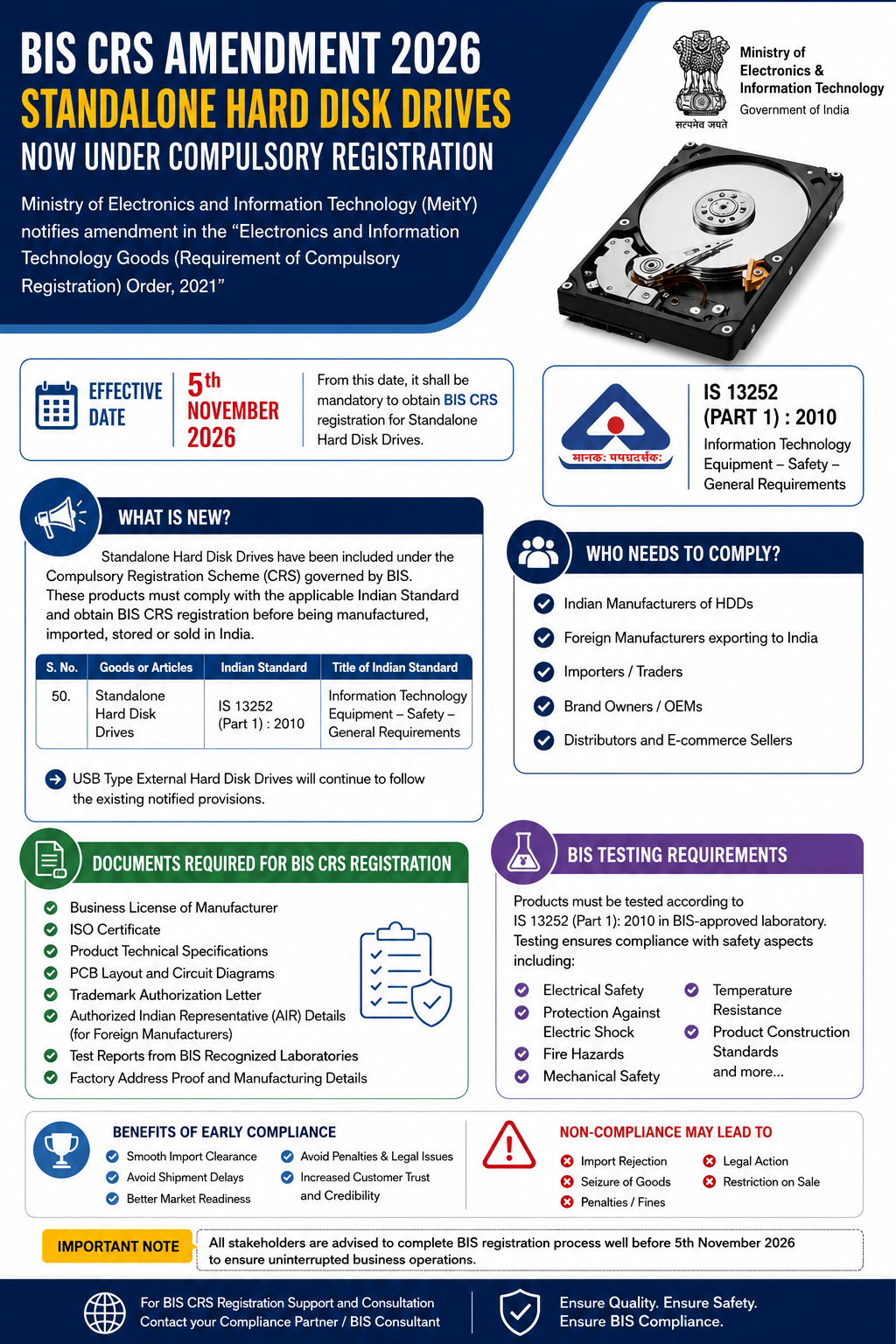
The Ministry of Electronics and Information Technology (MeitY), Government of India, has issued a new amendment under the “Electronics and Information Technology Goods (Requirement of Compulsory Registration) Order, 2021.” This latest notification, published in the Gazette of India on 5th May 2026, introduces important compliance requirements for Standalone Hard Disk Drives (HDDs) under the Compulsory Registration Scheme (CRS) governed by the Bureau of Indian Standards (BIS).
This update is highly significant for manufacturers, importers, brand owners, distributors, and e-commerce sellers dealing in storage devices in the Indian market. The amendment aims to ensure product safety, quality assurance, and consumer protection for electronic storage devices sold in India.
What is the New Amendment About?
As per the notification issued by MeitY, Standalone Hard Disk Drives have now been officially included under the Compulsory Registration Order (CRO). These products must comply with the applicable Indian Standard and obtain BIS CRS registration before being manufactured, imported, stored, or sold in India.
The amendment specifically mentions:
-
Product Category: Standalone Hard Disk Drives
-
Applicable Standard: IS 13252 (Part 1): 2010
-
Standard Title: Information Technology Equipment – Safety – General Requirements
The notification also clarifies that USB Type External Hard Disk Drives will continue to follow the existing notified provisions. However, all other standalone HDDs will come under the CRS framework from the effective date mentioned in the notification.
Effective Date of Implementation
According to the Gazette notification, the new compliance requirements for standalone hard disk drives will become effective from 5th November 2026.
From this date onward:
-
Non-compliant HDD products cannot be imported into India.
-
Manufacturers must obtain BIS CRS registration before market entry.
-
Products without valid BIS registration may face penalties, seizure, or market restrictions.
This provides businesses a limited transition period to complete testing, documentation, and registration formalities.
What is BIS CRS Registration?
BIS CRS (Compulsory Registration Scheme) is a mandatory product certification system introduced by the Government of India for electronic and IT products. Under this scheme:
-
Products are tested in BIS-recognized laboratories.
-
Manufacturers must comply with Indian safety standards.
-
Approved products receive BIS registration and can use the Standard Mark.
The CRS scheme helps ensure that electronic products sold in India meet minimum safety and quality requirements.
Who Needs to Comply?
The new amendment applies to:
-
Indian manufacturers of hard disk drives
-
Foreign manufacturers exporting HDDs to India
-
Importers and traders
-
Brand owners and OEM manufacturers
-
Online marketplace sellers
Any entity involved in supplying standalone hard disk drives to the Indian market must ensure BIS compliance before the implementation deadline.
Documents Required for BIS CRS Registration
To obtain BIS CRS registration for Standalone Hard Disk Drives, manufacturers generally need:
-
Business license of manufacturer
-
ISO certificate
-
Product technical specifications
-
PCB layout and circuit diagrams
-
Trademark authorization letter
-
Authorized Indian Representative (AIR) details for foreign manufacturers
-
Test reports from BIS-recognized laboratories
-
Factory address proof and manufacturing details
Proper documentation is essential for smooth approval from BIS authorities.
BIS Testing Requirements
Products must be tested according to IS 13252 (Part 1): 2010 in a BIS-approved laboratory. The testing process evaluates:
-
Electrical safety
-
Protection against electric shock
-
Fire hazards
-
Mechanical safety
-
Temperature resistance
-
Product construction standards
Only after successful testing can the manufacturer apply for BIS CRS certification.
Challenges Faced by Manufacturers
Many businesses face difficulties during the BIS registration process due to:
-
Complex technical documentation
-
Delays in testing
-
Incorrect labeling requirements
-
Coordination with laboratories
-
AIR appointment for foreign companies
-
Regulatory updates and compliance changes
Professional BIS consultants can help manufacturers avoid delays and ensure faster approvals.
Importance of Early Compliance
Since the notification becomes effective from 5th November 2026, companies should start the registration process immediately. BIS approvals and testing may take several weeks depending on product complexity and documentation readiness.
Early compliance offers several advantages:
-
Smooth import clearance
-
Avoidance of shipment delays
-
Better market readiness
-
Prevention of penalties and legal issues
-
Increased customer trust and credibility
Businesses delaying compliance may face disruptions in supply chains and sales operations.
Impact on the Electronics Industry
This amendment reflects the Indian government’s continued focus on product safety and quality regulation in the electronics sector. By bringing standalone hard disk drives under CRS, the government aims to:
-
Improve consumer safety
-
Eliminate substandard electronic products
-
Encourage quality manufacturing
-
Strengthen regulatory control over IT hardware
The move is also expected to support India’s growing digital and electronics ecosystem.
Conclusion
The inclusion of Standalone Hard Disk Drives under the BIS Compulsory Registration Scheme is an important regulatory development for the electronics industry in India. All manufacturers, importers, and brand owners dealing with HDD products must ensure compliance with IS 13252 (Part 1): 2010 before the effective date of 5th November 2026.
Businesses should begin testing and BIS registration procedures as early as possible to avoid operational delays and compliance risks. Proper planning, documentation, and expert guidance can help companies achieve smooth and timely BIS certification for their products.
For companies looking to enter or continue operations in the Indian electronics market, BIS CRS compliance is now a critical requirement for standalone hard disk drives.