
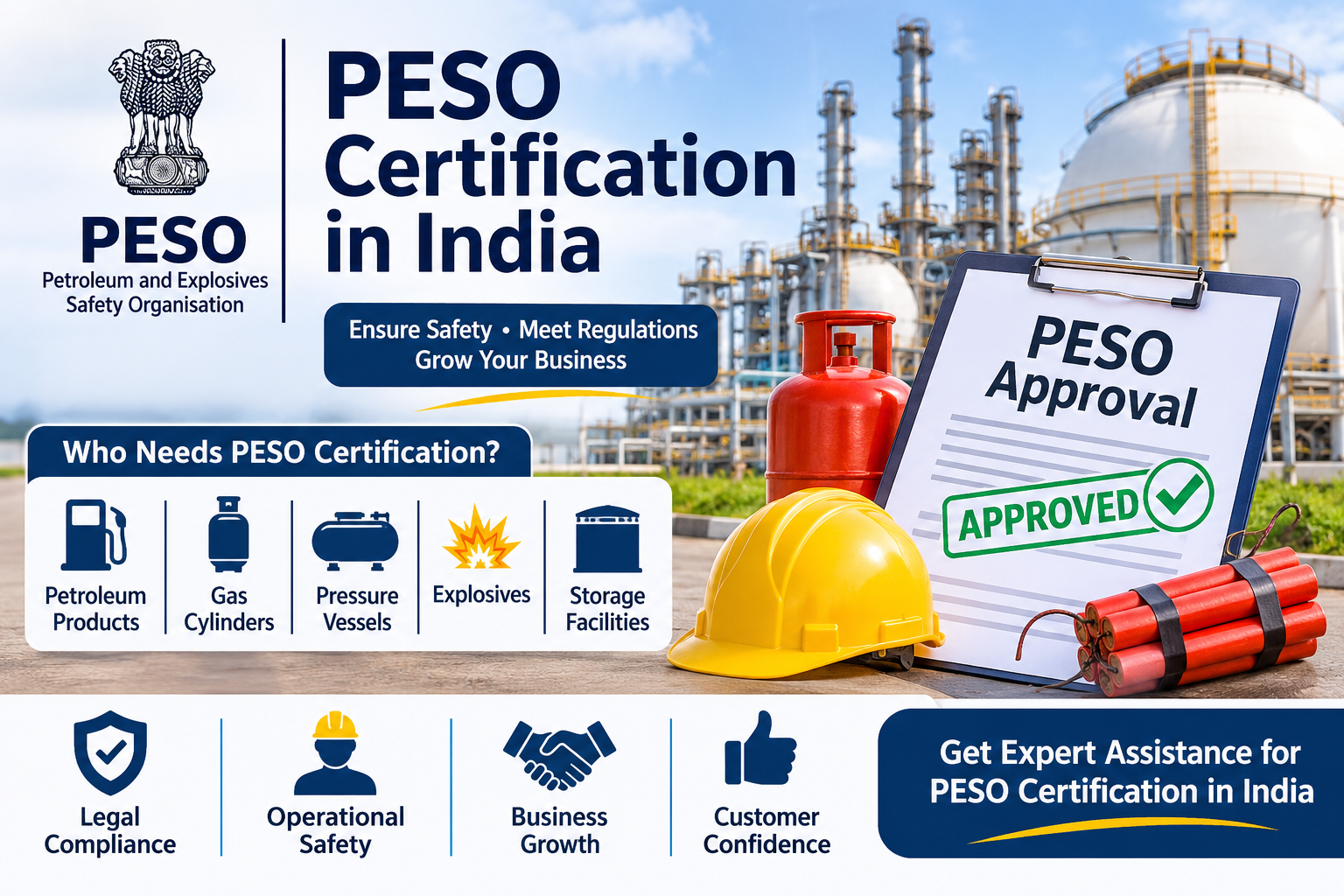
PESO Certification in India
PESO Certification in India is an important regulatory requirement for businesses involved in the manufacturing, importing, storage, transportation, and handling of petroleum products, explosives, compressed gases, and other hazardous substances. The Petroleum and Explosives Safety Organisation (PESO) is the government authority responsible for ensuring safety standards and regulatory compliance in these industries.
Businesses dealing with petroleum products, gas cylinders, pressure vessels, explosives, and hazardous equipment may require PESO approval, depending on their products and activities. Obtaining the appropriate PESO licence or certification helps companies meet Indian safety regulations and operate legally in the relevant sectors.
What is PESO Certification in India?
PESO Certification refers to the approval, licence, or registration issued by the Petroleum and Explosives Safety Organisation under applicable Indian laws and regulations. PESO operates under the Department for Promotion of Industry and Internal Trade (DPIIT), Ministry of Commerce and Industry, Government of India.
PESO regulates various activities related to industrial safety, including the storage and transportation of petroleum, compressed gases, explosives, and pressure vessels. It also evaluates certain equipment and products to ensure that they comply with applicable safety requirements.
Manufacturers, importers, distributors, and industrial establishments must identify the relevant PESO requirements before manufacturing, importing, installing, or operating regulated products and facilities.
Products and Industries Requiring PESO Approval
PESO approval may be applicable to different products and industrial activities, including:
Gas Cylinders: Manufacturing, importing, storage, and handling of regulated gas cylinders.
Pressure Vessels: Approval and compliance for applicable pressure vessels used in industrial applications.
Petroleum Products: Storage and handling of petroleum products, including regulated petroleum installations.
Explosives: Manufacturing, possession, storage, and transportation of explosives.
LPG Equipment: Applicable LPG storage systems, installations, and associated equipment.
Industrial Gas Equipment: Certain gas-handling equipment and installations.
Petroleum Storage Tanks: Approval for regulated petroleum storage facilities and installations.
The exact approval depends on the product category, intended use, technical specifications, and applicable regulations.
Important Acts and Regulations Under PESO
PESO administers and implements various Indian laws and regulations related to industrial safety. Important regulatory frameworks include:
Explosives Act, 1884
Explosives Rules, 2008
Petroleum Act, 1934
Petroleum Rules, 2002
Gas Cylinders Rules, 2016
Static and Mobile Pressure Vessels (Unfired) Rules, 2016
Ammonium Nitrate Rules, 2012
Businesses must identify the relevant legislation and applicable provisions before applying for PESO certification or licensing.
PESO Certification Process in India
Obtaining PESO certification involves several regulatory and technical steps. The process may vary depending on the product, installation, and type of licence required.
Step 1: Identify Applicable Requirements
First, determine whether your product, manufacturing activity, storage facility, or installation requires PESO approval under the applicable regulations.
Step 2: Documentation Preparation
Prepare the necessary technical and business documents, including company registration details, product specifications, engineering drawings, manufacturing details, and other supporting documents.
Step 3: Application Submission
Submit the relevant application through the applicable PESO process or online licensing system, along with the prescribed documents and fees.
Step 4: Technical Evaluation
PESO may review technical specifications, safety arrangements, engineering drawings, test reports, and other compliance documents.
Step 5: Inspection and Verification
Where applicable, the authority may conduct an inspection of the manufacturing facility, storage premises, or installation to verify compliance with safety requirements.
Step 6: Grant of Approval or Licence
After successful evaluation and fulfilment of applicable requirements, PESO may issue the relevant approval, registration, or licence.
Documents Required for PESO Certification
The documentation requirements depend on the applicable PESO licence or approval. Commonly required documents include:
Certificate of Incorporation or business registration.
PAN and GST registration details.
Company address proof.
Product technical specifications and drawings.
Manufacturing process details.
Equipment design and engineering drawings.
Test reports and safety certificates, wherever applicable.
Factory layout and site plan.
Storage and installation details.
Details of safety arrangements and emergency procedures.
Authorisation letter and applicant details.
Proper documentation helps reduce application queries and avoid unnecessary delays.
Benefits of PESO Certification
Obtaining PESO approval offers several important benefits to manufacturers, importers, and industrial businesses:
Legal Compliance: Helps businesses comply with applicable Indian safety laws and regulations.
Business Expansion: Supports companies planning to enter regulated petroleum, gas, and industrial equipment markets.
Operational Safety: Ensures that applicable safety requirements are addressed.
Import and Manufacturing Approval: Helps businesses obtain the required regulatory permissions for covered products and activities.
Customer Confidence: Demonstrates a commitment to regulatory compliance and industrial safety.
Reduced Compliance Risks: Helps avoid regulatory issues arising from operating without required licences or approvals.
Why Choose Professional PESO Certification Consultants in India?
The PESO approval process involves technical documentation, regulatory interpretation, application filing, and coordination with the concerned authorities. Professional PESO certification consultants can help manufacturers and importers understand the applicable requirements and manage the approval process efficiently.
An experienced consultant can assist with regulatory assessment, document preparation, technical coordination, application submission, query resolution, and licence renewal support.
Choosing the right PESO consultant helps businesses save time, minimise documentation errors, and maintain regulatory compliance.
Frequently Asked Questions (FAQs)
1. What is the full form of PESO?
PESO stands for Petroleum and Explosives Safety Organisation, a government regulatory organisation under DPIIT.
2. Is PESO certification mandatory in India?
PESO approval or licensing is mandatory for activities and products covered under the applicable petroleum, explosives, gas cylinders, and pressure vessel regulations.
3. How much time does PESO certification take?
The timeline depends on the approval category, documentation, technical evaluation, and inspection requirements. There is no single fixed timeline for all applications.
4. Can foreign manufacturers apply for PESO approval?
Yes. Foreign manufacturers and importers can obtain applicable PESO approvals subject to the relevant Indian regulations and application requirements.
5. How can I apply for a PESO licence?
Applicants can register through the National Single Window System (NSWS) and access the relevant PESO application process.
6. Does PESO approval require renewal?
Renewal requirements and validity depend on the specific licence category and applicable rules.
Get Expert Assistance for PESO Certification in India
Looking for reliable PESO Certification Consultants in India? Professional regulatory guidance can make the approval process easier for manufacturers, importers, and industrial businesses.
Our PESO consultancy support covers regulatory assessment, documentation, technical coordination, application filing, approval follow-ups, and renewal assistance.
Whether you need PESO approval for gas cylinders, pressure vessels, petroleum storage tanks, industrial gas equipment, or other regulated products, expert guidance can help you navigate the applicable compliance requirements.
Representative Client's