
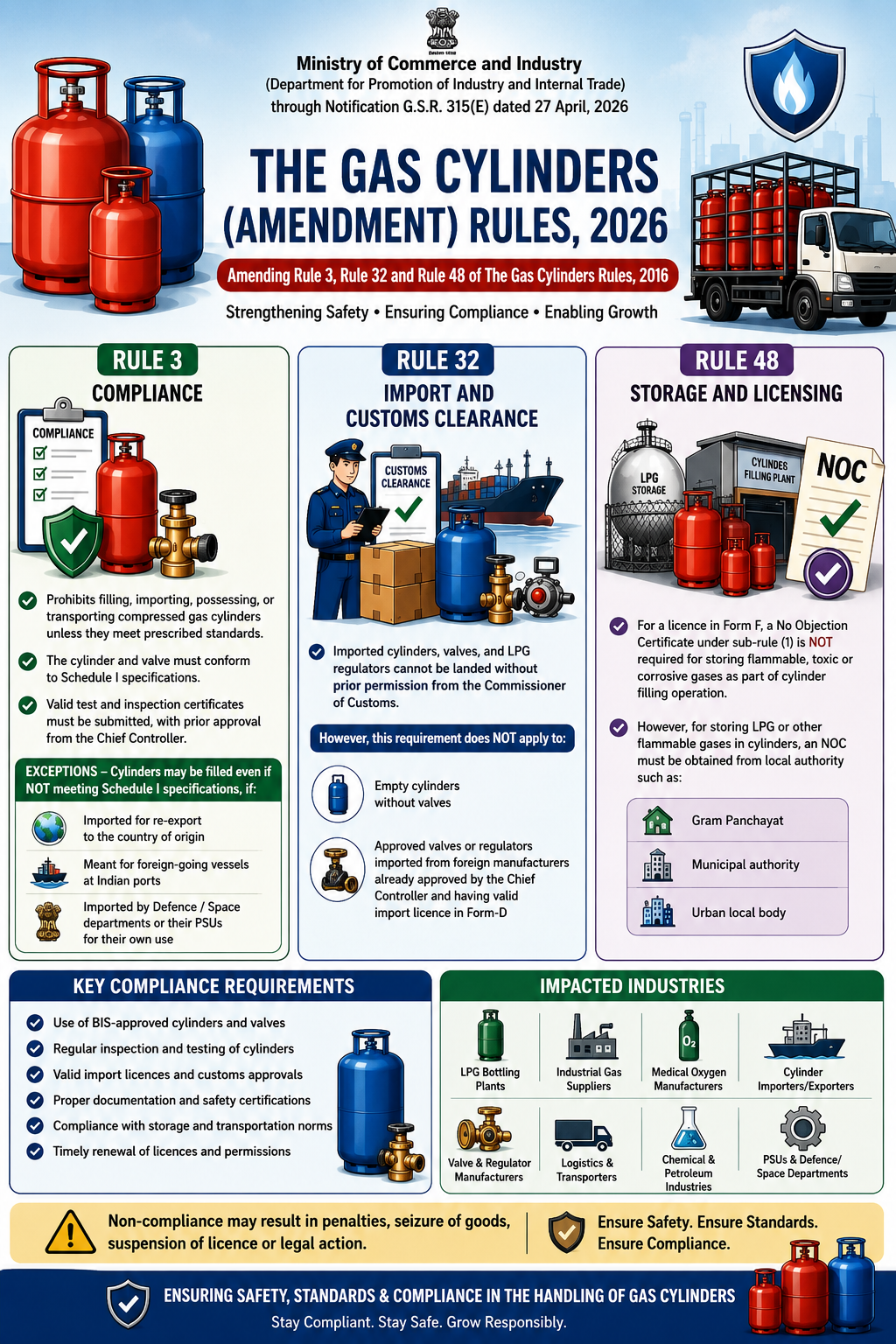
Gas Cylinders (Amendment) Rules,2026
The Ministry of Commerce and Industry, through the Department for Promotion of Industry and Internal Trade (DPIIT), has introduced the Gas Cylinders (Amendment) Rules, 2026, under Notification G.S.R. 315(E) dated 27 April 2026. These amendments are designed to strengthen safety standards, improve compliance procedures, and regulate the manufacturing, import, storage, transportation, and use of compressed gas cylinders across India.
The updated rules amend key provisions of the Gas Cylinders Rules, 2016, particularly Rule 3, Rule 32, and Rule 48. These changes are highly important for manufacturers, importers, LPG plant operators, logistics companies, and businesses dealing with industrial or medical gas cylinders.
Purpose of the Amendment Rules 2026
The primary objective of these amendments is to ensure safer handling and movement of gas cylinders while simplifying certain regulatory procedures. With the increasing demand for LPG, industrial gases, oxygen cylinders, and compressed gas systems, the government has strengthened compliance mechanisms to reduce safety risks and unauthorized handling.
The amendment rules also align India’s gas cylinder management framework with international safety standards and promote better monitoring of imported cylinders and valves.
Amendment in Rule 3 – Compliance Requirements
Rule 3 focuses on the basic compliance conditions for filling, importing, possessing, and transporting compressed gas cylinders.
Under the amended provisions:
No person is allowed to fill, import, possess, or transport compressed gas cylinders unless they comply with prescribed standards.
Cylinders and valves must conform to the specifications listed in Schedule I of the Gas Cylinders Rules.
Valid inspection and testing certificates are mandatory before approval from the Chief Controller is granted.
This amendment strengthens accountability among cylinder manufacturers and importers. It ensures that only certified cylinders meeting approved safety standards are used within the Indian market.
Exceptions Under Rule 3
The amendment also provides certain exemptions where cylinders may be filled even if they do not fully meet Schedule I specifications. These include:
Cylinders imported for re-export to the country of origin
Cylinders intended for foreign-going vessels at Indian ports
Cylinders imported by Defence or Space departments and their Public Sector Undertakings (PSUs) for official use
These exemptions are provided under controlled conditions to avoid operational delays in strategic and international sectors.
Amendment in Rule 32 – Import and Customs Clearance
Rule 32 deals with the import process and customs clearance for gas cylinders, valves, and LPG regulators.
According to the amended rule:
Imported cylinders, valves, and LPG regulators cannot be cleared or landed without prior permission from the Commissioner of Customs.
Importers must obtain approvals and maintain valid documentation before the products are released.
This change improves traceability and ensures that substandard imported products do not enter the Indian market.
Exemptions Under Rule 32
The customs clearance requirement does not apply in certain cases, such as:
Empty cylinders without valves
Approved valves or LPG regulators imported from foreign manufacturers already approved by the Chief Controller and holding a valid import license in Form-D
These exemptions reduce unnecessary procedural hurdles for approved and compliant businesses.
Amendment in Rule 48 – Storage and Licensing
Rule 48 relates to licensing requirements for LPG storage and cylinder filling facilities.
Under the updated rules:
For obtaining a license in Form F for a cylinder filling plant, a No Objection Certificate (NOC) under sub-rule (1) is not required for storing flammable, toxic, or corrosive gases as part of the filling operation.
However, for LPG storage or storage of other flammable gases in cylinders, businesses must obtain an NOC from the local authority such as:
Gram Panchayat
Municipal authority
Urban local body
This amendment simplifies operations for licensed filling plants while ensuring local safety approvals for storage facilities.
Impact on Businesses
The Gas Cylinders (Amendment) Rules, 2026 will directly impact several industries, including:
LPG bottling plants
Industrial gas suppliers
Medical oxygen manufacturers
Cylinder importers and exporters
Valve and regulator manufacturers
Logistics and transportation companies
Chemical and petroleum industries
Businesses dealing with compressed gases must review their compliance systems immediately to avoid penalties, delays, or cancellation of licenses.
Key Compliance Requirements
To comply with the amended rules, businesses should ensure:
Use of BIS-approved cylinders and valves
Regular cylinder inspection and testing
Valid import licenses and customs approvals
Proper documentation and safety certifications
Compliance with storage and transportation norms
Timely renewal of licenses and permissions
Failure to comply may result in legal action, seizure of goods, penalties, or suspension of operations.
Importance of Professional Compliance Support
The compliance process for gas cylinders involves technical documentation, testing approvals, PESO permissions, and customs coordination. Many businesses prefer professional consultants to manage these regulatory requirements smoothly.
A compliance consultant can help with:
PESO approvals
Import permissions
Documentation support
Cylinder testing coordination
License applications and renewals
Regulatory audits and inspections
Professional guidance helps businesses reduce approval delays and maintain uninterrupted operations.
Conclusion
The Gas Cylinders (Amendment) Rules, 2026 represent an important step toward improving safety, compliance, and operational efficiency in India’s gas handling sector. By strengthening rules related to cylinder standards, imports, storage, and licensing, the government aims to create a safer and more regulated environment for compressed gas operations.
Businesses involved in manufacturing, importing, storing, or transporting gas cylinders should carefully understand these amendments and implement the required compliance measures immediately. Proper adherence to the updated rules will not only ensure legal compliance but also improve operational safety and business credibility.
Representative Client's