
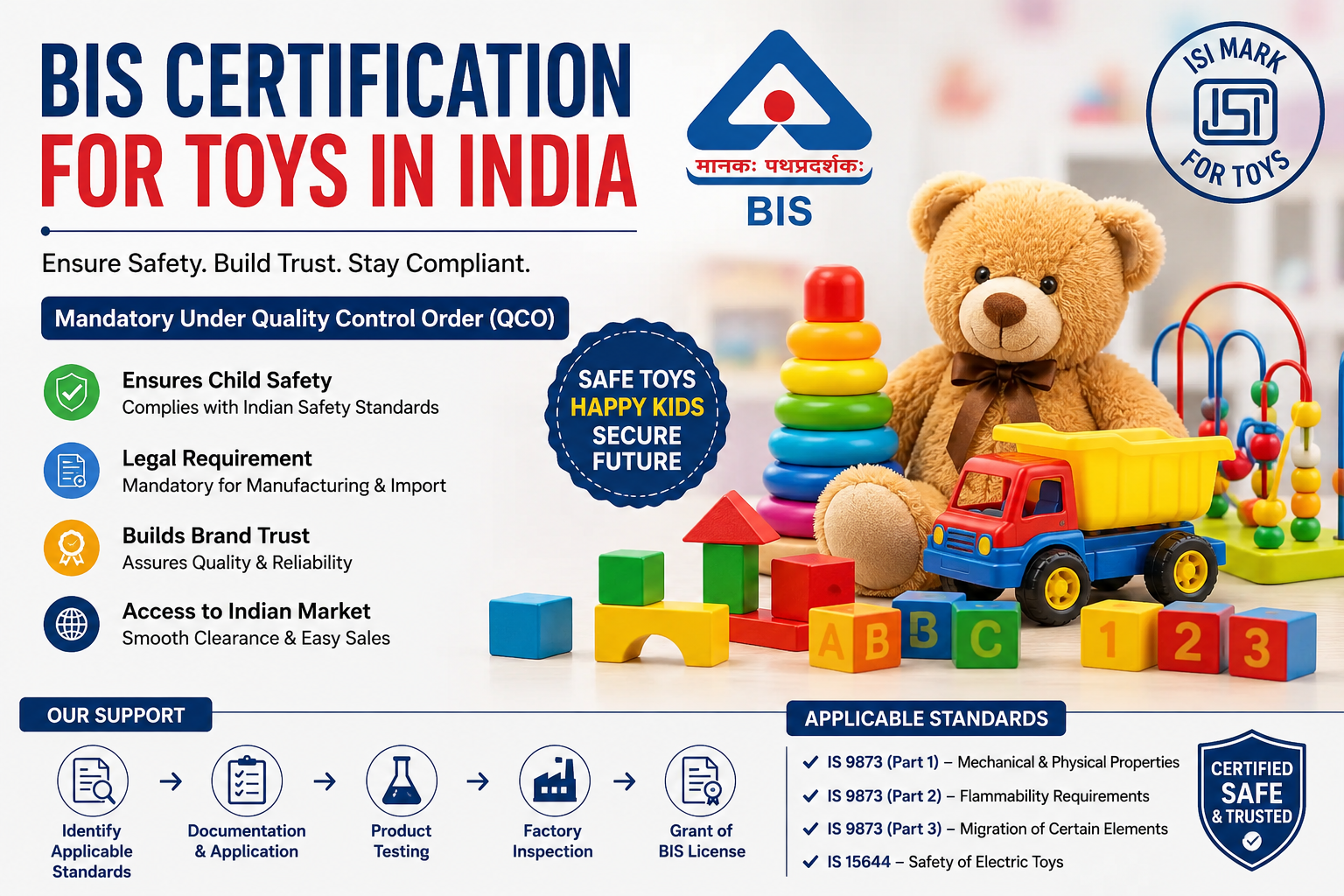
BIS Certification for Toys in India
The Indian toy industry has witnessed significant growth in recent years, driven by increasing consumer demand, government initiatives promoting domestic manufacturing, and stricter quality regulations. To ensure that toys sold in the Indian market are safe for children, the Government of India has made BIS Certification for Toys mandatory. Manufacturers, importers, and foreign toy brands must comply with the relevant Indian Standards and obtain the necessary certification before selling their products in India.
What is BIS Certification for Toys?
BIS (Bureau of Indian Standards) Certification is a quality assurance mark that confirms a product complies with the applicable Indian Standards. For toys, BIS certification is mandatory under the Quality Control Order (QCO) issued by the Government of India.
The certification ensures that toys meet stringent safety, mechanical, physical, chemical, and flammability requirements. It helps protect children from hazardous materials, sharp edges, choking hazards, and other potential risks associated with unsafe toys.
Any manufacturer producing toys for the Indian market, whether located in India or overseas, must obtain BIS certification before supplying or importing toys into India.
Applicable Indian Standards for Toys
The primary Indian Standards applicable to toys include:
IS 9873 (Part 1): Safety Aspects Related to Mechanical and Physical Properties
IS 9873 (Part 2): Flammability Requirements
IS 9873 (Part 3): Migration of Certain Elements
IS 15644: Safety of Electric Toys
The applicable standard depends on the type of toy being manufactured. Manufacturers must ensure that their products comply with all relevant requirements before applying for certification.
Who Needs BIS Certification for Toys?
BIS Certification is mandatory for:
Indian toy manufacturers
Foreign toy manufacturers exporting to India
Importers dealing in toys
Brand owners selling toys under their own label
E-commerce sellers offering toys in the Indian market
Selling non-certified toys in India can result in product seizure, penalties, cancellation of import consignments, and legal action under applicable regulations.
Types of Toys Covered
BIS Certification applies to a wide variety of toys, including:
Plastic toys
Wooden toys
Educational toys
Battery-operated toys
Electronic toys
Soft toys
Ride-on toys
Building blocks
Dolls and action figures
Musical toys
Outdoor play equipment
Puzzle games
Whether the toy is designed for infants, toddlers, or older children, certification is required if it falls under the notified categories.
BIS Certification Process for Toys
The certification process generally includes the following steps:
1. Product Assessment
The manufacturer identifies the applicable Indian Standard based on the toy category and technical specifications.
2. Documentation
Necessary documents are prepared, including:
Business registration certificate
Manufacturing license
Factory layout
Product specifications
Quality control documents
Testing details
Trademark authorization (if applicable)
3. Product Testing
Samples are tested in a BIS-recognized laboratory to verify compliance with applicable safety standards.
4. Factory Inspection
For applicable certification schemes, BIS officials inspect the manufacturing facility to verify production capability and quality control systems.
5. Grant of BIS License
After successful evaluation of test reports, inspection findings, and documentation, BIS grants the certification license allowing the manufacturer to use the Standard Mark.
Documents Required
Common documents required include:
Company registration documents
Factory registration certificate
Manufacturing process flow chart
Product drawings and specifications
List of manufacturing machinery
Quality control equipment details
Authorized signatory documents
Product test reports
Trademark documents
ISO certification (if available)
The exact document requirements may vary depending on whether the applicant is an Indian or foreign manufacturer.
Benefits of BIS Certification for Toys
Obtaining BIS Certification provides several advantages:
Legal authorization to sell toys in India
Compliance with Government regulations
Improved consumer confidence
Enhanced product safety
Better market acceptance
Increased credibility among distributors and retailers
Reduced risk of product recalls
Smooth customs clearance for imported toys
Competitive advantage in the Indian market
Certified products also demonstrate the manufacturer's commitment to quality and child safety.
Why is BIS Certification Important?
Children are highly vulnerable to unsafe products. Poor-quality toys may contain toxic chemicals, detachable small parts, sharp edges, or flammable materials that can pose serious health and safety risks.
BIS Certification minimizes these risks by ensuring that toys undergo comprehensive testing before reaching consumers. It also promotes fair competition by preventing the sale of substandard products in the Indian market.
Challenges Faced by Manufacturers
Manufacturers often encounter challenges such as:
Identifying applicable standards
Preparing technical documentation
Product testing requirements
Factory audit compliance
Correct labeling and marking
Timely approval process
Handling non-conformities
Working with experienced BIS consultants can simplify the certification process and reduce delays.
Why Choose a BIS Certification Consultant?
A professional BIS consultant assists manufacturers throughout the certification journey by:
Determining applicable standards
Preparing complete documentation
Coordinating laboratory testing
Assisting during factory inspections
Responding to BIS queries
Monitoring application progress
Ensuring compliance with regulatory requirements
Expert guidance helps manufacturers obtain certification efficiently while avoiding costly errors.
Conclusion
BIS Certification for Toys in India is a mandatory regulatory requirement that ensures toys meet established safety and quality standards before entering the Indian market. Whether you are an Indian manufacturer, foreign exporter, importer, or brand owner, obtaining BIS certification is essential for legal compliance and consumer trust.
With proper documentation, product testing, and regulatory support, manufacturers can achieve BIS certification smoothly and expand their business confidently in one of the world's fastest-growing toy markets. Investing in compliance not only fulfills legal obligations but also reinforces your commitment to delivering safe, reliable, and high-quality toys to children across India.
Representative Client's