
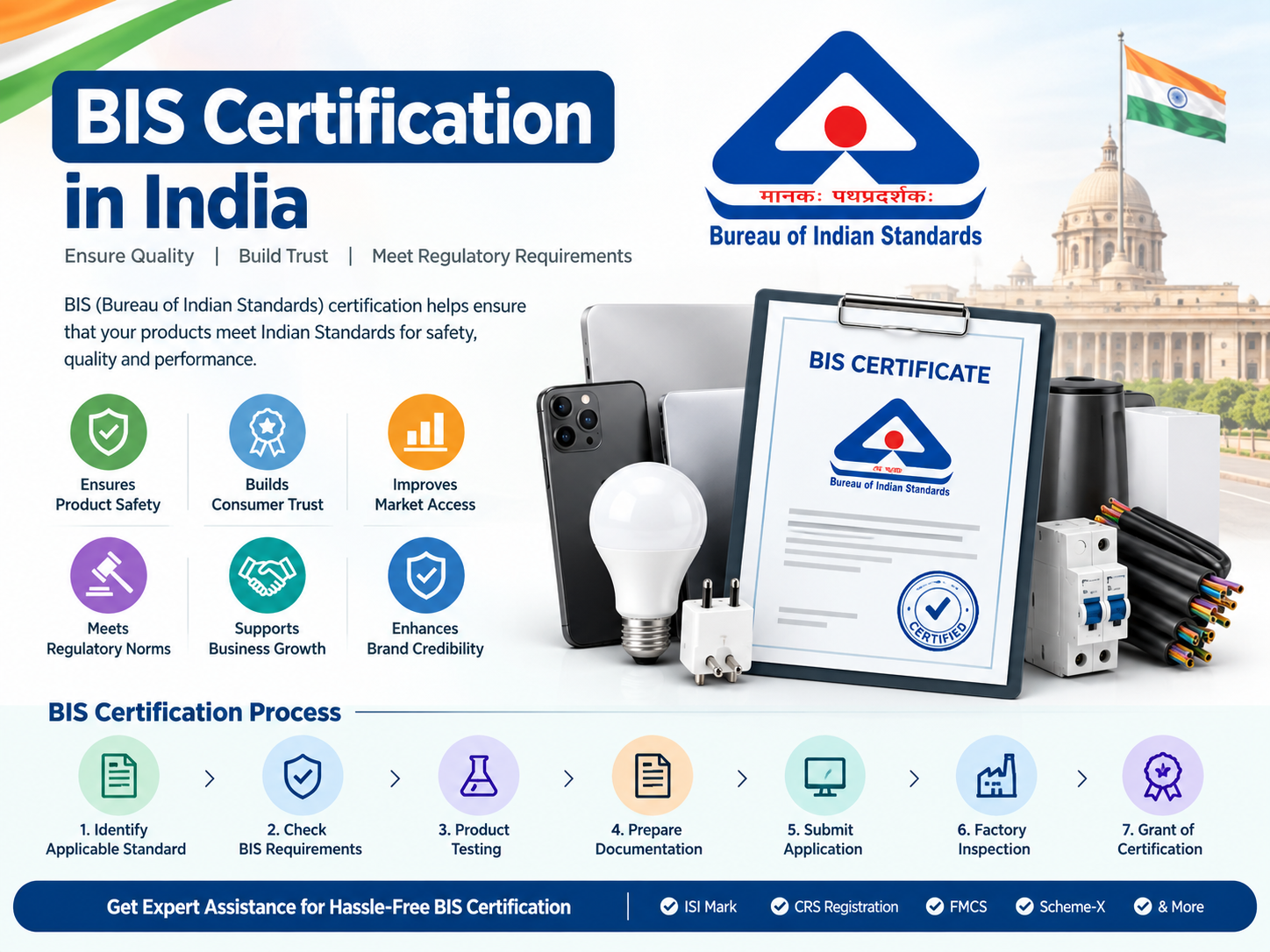
BIS Certification in India
BIS Certification in India is an important product conformity assessment system that helps ensure products meet the applicable Indian Standards for quality, safety, reliability, and performance. The Bureau of Indian Standards (BIS) is the national standards body responsible for developing Indian Standards and operating various conformity assessment schemes for products manufactured or imported into India.
For manufacturers, importers, foreign companies, and Indian brands, obtaining the applicable BIS approval can be an important regulatory requirement before selling certain products in the Indian market. Depending on the product and applicable Quality Control Order (QCO), businesses may need BIS certification, BIS registration, or another BIS conformity assessment route.
What is BIS Certification?
BIS Certification is a process through which a product is assessed against the requirements of a relevant Indian Standard. The process may involve product testing, factory inspection, documentation review, and assessment by BIS or a BIS-recognized laboratory, depending on the applicable certification scheme.
BIS certification demonstrates that a product complies with specified technical requirements. It can help businesses establish product credibility while supporting regulatory compliance in the Indian market.
The requirement for BIS certification depends on the product category, applicable Indian Standard, and government notification or Quality Control Order covering that product.
Why is BIS Certification Important in India?
BIS compliance is important because many products sold in India are regulated to protect consumers and maintain product quality. For products covered by mandatory BIS requirements, manufacturers may need to obtain the appropriate approval before manufacturing, importing, storing, distributing, or selling the product in India.
Some key benefits include:
Helps meet applicable Indian regulatory requirements
Demonstrates conformity with relevant Indian Standards
Supports consumer safety and product quality
Improves market acceptance and customer confidence
Helps businesses participate in certain tenders and procurement opportunities
Supports import and market-entry requirements for regulated products
Strengthens the credibility of manufacturers and brands
For businesses planning to launch a new product in India, identifying the applicable BIS requirement at an early stage can help prevent compliance delays.
Types of BIS Certification and Registration
BIS operates different conformity assessment schemes depending on the nature of the product and applicable regulations. Common routes include the following:
1. BIS ISI Mark Certification
The BIS ISI Mark is associated with products manufactured according to applicable Indian Standards. Under the BIS certification scheme, the manufacturing facility and product may be assessed through testing, inspection, and other conformity assessment procedures.
Products covered by mandatory certification requirements generally need the applicable BIS licence before being sold in India.
2. BIS CRS Registration
The Compulsory Registration Scheme (CRS) applies to specified electronic and IT products. Manufacturers of products covered under CRS may need to obtain BIS registration based on testing at a BIS-recognized laboratory.
The registration process generally involves product testing, submission of required documents, and application through the applicable BIS online system.
3. BIS FMCS
The Foreign Manufacturers Certification Scheme (FMCS) provides a route for eligible foreign manufacturers to obtain BIS certification for products manufactured outside India.
Foreign manufacturers may need to appoint an authorized Indian representative and meet the relevant requirements related to factory facilities, testing, documentation, and product conformity.
4. BIS Scheme-X Certification
Scheme-X is a BIS conformity assessment route applicable to certain products and product categories covered by the relevant regulations. Depending on the product, manufacturers may need to meet specified requirements related to testing, factory assessment, quality management, and conformity.
Businesses should determine whether Scheme-X applies to their specific product before beginning the certification process.
BIS Certification Process in India
The exact BIS certification procedure depends on the applicable scheme and product standard. However, the process generally includes several important stages.
Step 1: Identify the Applicable Indian Standard
The first step is to identify the correct Indian Standard applicable to the product. Product specifications, intended use, technical characteristics, and applicable government notifications may need to be reviewed.
Step 2: Check Mandatory BIS Requirements
Not every product requires mandatory BIS certification. Businesses should verify whether the product is covered under a mandatory Quality Control Order, BIS scheme, or other applicable regulation.
Step 3: Product Testing
The product may need to be tested according to the requirements of the applicable Indian Standard. Testing may be conducted through a BIS-recognized or otherwise applicable laboratory, depending on the certification route.
Step 4: Prepare Documentation
Typical documentation may include:
Manufacturing details
Product technical specifications
Test reports
Factory address and details
Manufacturing process information
Quality control documents
Machinery and testing equipment details
Raw material information
Authorized representative details
Trademark or brand-related documents, where applicable
Other documents required under the relevant scheme
Step 5: Submit BIS Application
After completing the required preparation, the applicant submits the application and supporting documents through the applicable BIS process.
Step 6: Factory Inspection
Where required, BIS officials may inspect the manufacturing facility to verify production capabilities, quality control systems, testing facilities, and other applicable requirements.
Step 7: Compliance and Grant of Approval
If the product and manufacturing facility meet the applicable requirements, BIS may grant the relevant licence or registration, subject to the conditions of the applicable scheme.
Who Needs BIS Certification in India?
BIS requirements can apply to different types of businesses, including:
Indian manufacturers
Foreign manufacturers
Importers
Brand owners
Product suppliers
Electronics and IT product manufacturers
Electrical product manufacturers
Consumer product manufacturers
Machinery and industrial product manufacturers
However, applicability must always be determined based on the specific product and current regulatory requirements.
Role of a BIS Consultant
A BIS consultant can help businesses understand the applicable certification route and coordinate the compliance process. Professional BIS consultants may assist with standard identification, documentation, laboratory testing coordination, application preparation, factory inspection preparation, and communication related to the certification process.
For manufacturers unfamiliar with Indian regulatory procedures, professional assistance can help reduce documentation errors and improve the overall efficiency of the certification process.
Documents Required for BIS Certification
The documents required depend on the product and certification scheme. Common documents can include company registration documents, manufacturing address proof, technical specifications, product drawings, test reports, quality control details, machinery information, testing equipment details, raw material information, authorization documents, and trademark-related documents.
It is important to prepare documents according to the exact requirements of the applicable BIS scheme rather than using a generic document checklist.
Benefits of BIS Certification
Obtaining the applicable BIS approval can provide several advantages to businesses operating in India:
Regulatory Compliance: Helps businesses meet applicable mandatory product requirements.
Consumer Confidence: Demonstrates that the product has been assessed against specified standards.
Market Access: For regulated products, obtaining the required approval can be necessary for lawful market entry.
Business Credibility: BIS compliance can strengthen the reputation of a manufacturer or brand.
Tender Opportunities: Certain government and institutional procurement requirements may specify relevant standards or certifications.
Quality Assurance: The certification process encourages systematic quality control and conformity with technical requirements.
How Long Does BIS Certification Take?
The timeline varies depending on the product, certification scheme, testing requirements, documentation, factory readiness, and BIS assessment process. Testing delays, incomplete documents, manufacturing deficiencies, or inspection-related observations can increase the overall timeline.
Therefore, businesses should start the compliance process well before their planned product launch or import schedule.
Why Choose Professional BIS Certification Consultants?
BIS certification can involve technical standards, laboratory testing, documentation, factory assessment, and regulatory procedures. A professional consultant can help coordinate these activities and provide guidance throughout the process.
An experienced BIS consultant can help identify the appropriate Indian Standard, coordinate testing, review documentation, prepare the manufacturer for inspection, and support the application process.
Conclusion
BIS Certification in India plays an important role in ensuring that regulated products meet applicable Indian Standards for safety, quality, and performance. Whether you are an Indian manufacturer, foreign manufacturer, importer, or brand owner, it is important to determine the correct BIS requirement before introducing a regulated product into the Indian market.
The right certification route may include ISI Mark Certification, BIS CRS Registration, FMCS, Scheme-X, or another applicable BIS conformity assessment process. Since requirements differ by product and can change through government notifications and Quality Control Orders, businesses should verify the latest applicable requirements before applying.
Professional BIS consultants can assist manufacturers with standard identification, testing, documentation, application preparation, factory inspection, and overall compliance coordination, making the certification process more structured and manageable.
Representative Client's