
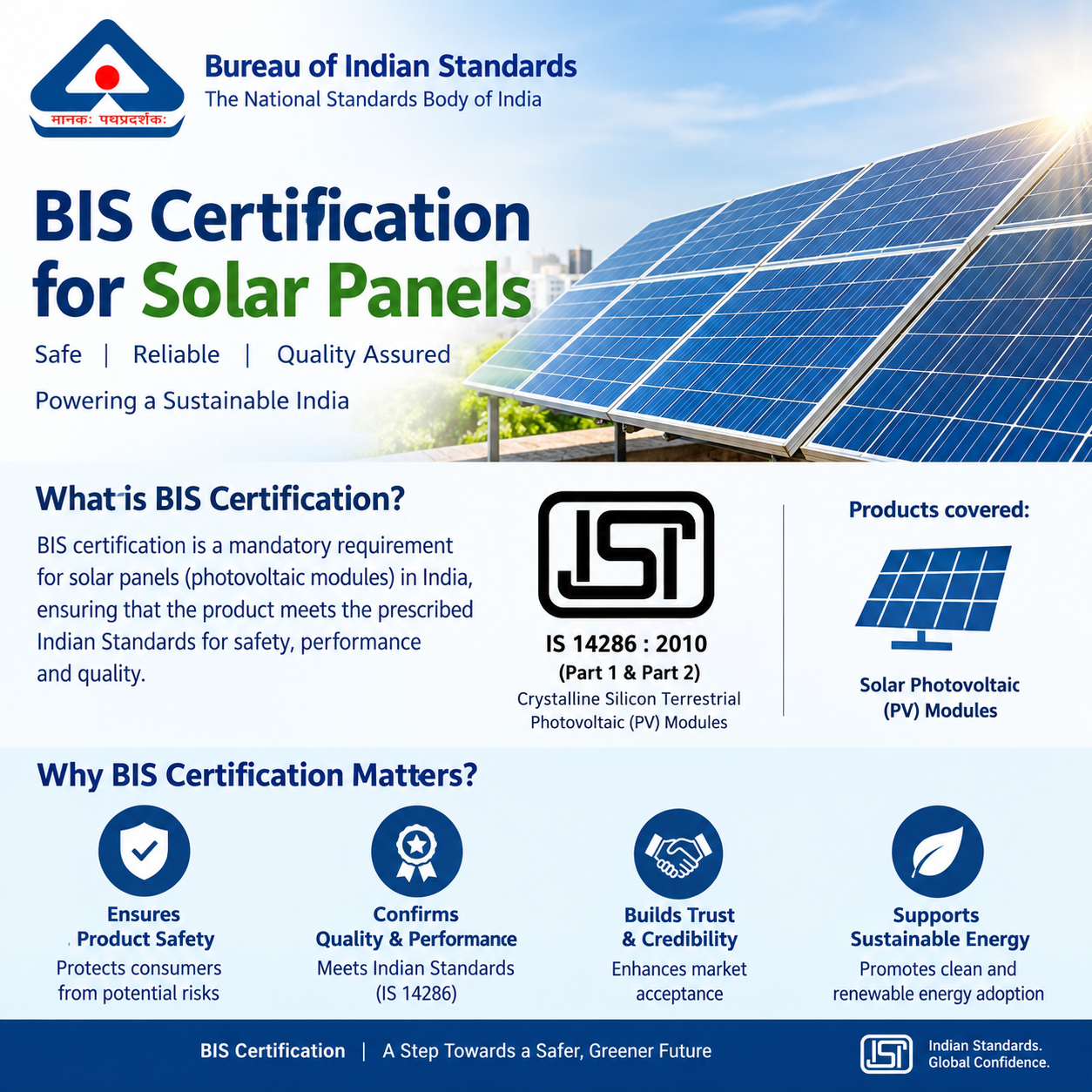
BIS Certification for Solar Panels in India
BIS Certification for solar panels is an important regulatory requirement for manufacturers and suppliers seeking to market applicable solar photovoltaic products in India. The Bureau of Indian Standards (BIS) certification process helps ensure that solar panels meet the relevant Indian Standards for safety, quality, performance, and reliability.
Solar photovoltaic (PV) modules are widely used in residential, commercial, industrial, and utility-scale solar projects. As the use of renewable energy continues to grow, compliance with applicable Indian regulatory requirements has become increasingly important for manufacturers, importers, and other businesses involved in the solar industry.
What is BIS Certification for Solar Panels?
BIS Certification is a conformity assessment mechanism through which products are assessed against applicable Indian Standards. For solar panels and photovoltaic modules, the applicable requirements depend on the product type, technology, specifications, and relevant Quality Control Orders (QCOs) or other government notifications.
Manufacturers may need to identify the applicable Indian Standard, conduct testing through the prescribed laboratory, prepare technical documentation, and complete the required BIS certification or registration procedure.
The objective is to ensure that products placed in the Indian market comply with specified technical and safety requirements.
Why is BIS Certification Important for Solar Panels?
Solar panels are exposed to outdoor environmental conditions for long periods. They must withstand factors such as sunlight, temperature variations, humidity, mechanical loads, and other environmental stresses.
BIS compliance can help manufacturers demonstrate that their products have been evaluated against applicable standards.
Key benefits include:
Demonstrates conformity with applicable Indian Standards
Supports product quality and safety requirements
Helps manufacturers meet applicable regulatory obligations
Facilitates compliance for products covered by mandatory requirements
Builds confidence among buyers and project developers
Supports participation in applicable procurement and tender opportunities
Helps establish a structured product testing and documentation process
Applicable Standards for Solar PV Modules
The applicable Indian Standard depends on the type and characteristics of the photovoltaic module. Solar PV products may be covered by standards relating to design qualification, safety, performance, construction, and testing.
Manufacturers should verify the latest BIS requirements and applicable Quality Control Orders before starting the certification process because standards, product categories, and regulatory requirements can be updated.
For solar PV modules, testing may cover various characteristics related to electrical performance, environmental durability, mechanical strength, insulation, safety, and long-term operation.
A proper assessment of the product specification is therefore an important first step before applying for certification.
Who Needs BIS Certification for Solar Panels?
Depending on the applicable regulations, BIS requirements may affect:
Indian solar panel manufacturers
Foreign manufacturers supplying products to India
Importers of solar PV modules
Suppliers and distributors dealing in regulated products
Manufacturers participating in government or institutional procurement
Businesses introducing new solar module models into the Indian market
The exact obligation should be determined based on the product, applicable standard, manufacturing location, and current regulatory notification.
BIS Certification Process for Solar Panels
The BIS certification process generally involves several stages.
1. Identify the Applicable Standard
The first step is to determine the Indian Standard applicable to the solar panel or photovoltaic module. Product specifications, technology, construction, ratings, and intended application may need to be reviewed.
2. Product Testing
The product may need to undergo testing according to the applicable Indian Standard and prescribed BIS requirements. Testing can involve electrical, mechanical, environmental, safety, and performance-related parameters.
3. Prepare Technical Documentation
Manufacturers generally need to maintain appropriate technical documents, which may include:
Product specifications
Drawings and diagrams
Bill of materials
Manufacturing process information
Test reports
Quality control procedures
Calibration records
Details of manufacturing facilities
Raw material information
Product identification and marking details
4. Submit the Application
The manufacturer submits the relevant application and supporting documentation through the applicable BIS process.
5. Factory Assessment, Where Applicable
Depending on the applicable conformity assessment scheme, BIS may assess the manufacturing facility and quality-control arrangements. The assessment can include verification of production processes, testing facilities, inspection procedures, and quality-management practices.
6. Review and Compliance
BIS reviews the submitted documents, test results, and other applicable compliance information. If deficiencies are identified, the applicant may need to address them before certification or registration can be completed.
7. Grant of Certification
Once the applicable requirements are successfully fulfilled, BIS may grant the relevant certification or registration, subject to the applicable scheme and regulatory requirements.
Documents Required for BIS Certification
The exact documentation varies according to the applicable certification scheme. Commonly required information may include:
Manufacturer details
Factory address
Product specifications
Technical drawings
Product catalogue
Bill of materials
Manufacturing process details
Test reports
Quality-control plan
Testing equipment details
Calibration certificates
Raw material specifications
Authorized signatory information
Brand or trademark information
Foreign manufacturers may also have additional documentation requirements depending on the applicable BIS procedure.
Role of Testing in Solar Panel Certification
Testing is a critical part of solar panel compliance. Photovoltaic modules must demonstrate conformity with the relevant technical requirements before they can be considered compliant under an applicable mandatory certification framework.
Testing may examine parameters such as electrical characteristics, insulation properties, environmental resistance, mechanical durability, and other specified performance or safety requirements.
Manufacturers should ensure that testing is conducted according to the applicable BIS procedure and at laboratories recognized or permitted under the relevant requirements.
BIS Certification for Imported Solar Panels
Importers and foreign manufacturers should carefully review Indian regulatory requirements before shipping solar panels to India.
Where mandatory BIS requirements apply, products may need to comply before being placed on the Indian market. Foreign manufacturers may also need to complete the applicable BIS procedure through the relevant foreign manufacturer certification or registration route.
Importers should verify certification status, product scope, model details, manufacturing location, and applicable regulatory requirements rather than relying only on a supplier's general compliance statement.
Common Compliance Challenges
Businesses can face several challenges during the BIS certification process, including:
Selecting the wrong Indian Standard
Incomplete technical documentation
Incorrect product grouping
Testing gaps
Differences between tested products and production models
Inadequate factory quality-control systems
Incorrect product markings
Delays in resolving technical observations
Changes in applicable standards or regulations
Early compliance planning can help reduce avoidable delays.
How a BIS Consultant Can Help
A BIS consultant can assist manufacturers and importers with regulatory assessment, applicable standard identification, documentation, testing coordination, application preparation, and communication during the certification process.
Professional consultancy may be particularly useful for businesses dealing with multiple solar panel models, imported products, foreign manufacturing facilities, or complex technical documentation.
However, certification should always be based on the actual applicable BIS requirements and the product's technical characteristics.
Conclusion
BIS Certification for solar panels is an important compliance consideration for manufacturers, importers, and suppliers operating in India's photovoltaic market. The process involves identifying the applicable Indian Standard, completing required testing, preparing technical documentation, meeting quality-control requirements, and following the relevant BIS conformity assessment procedure.
Because regulatory requirements can change, businesses should verify the latest applicable BIS notifications, standards, and Quality Control Orders before beginning the certification process. Proper planning and documentation can help manufacturers maintain regulatory compliance and support smoother access to the Indian market.
Frequently Asked Questions
1. Is BIS Certification mandatory for solar panels in India?
It depends on the specific solar PV product and the applicable government notification, Quality Control Order, or BIS requirement. Businesses should verify the current requirements for their exact product.
2. What standard applies to solar panels?
The applicable Indian Standard depends on the type, construction, technology, and specifications of the photovoltaic product. The correct standard should be identified before testing.
3. Can foreign manufacturers obtain BIS certification for solar panels?
Yes, where applicable, foreign manufacturers can follow the relevant BIS procedure for overseas manufacturers.
4. What testing is required for solar panels?
Testing depends on the applicable standard and product category and may cover electrical, safety, environmental, mechanical, and performance parameters.
5. How long does BIS certification take?
The timeline varies according to the product, testing requirements, documentation, factory assessment, and BIS review process.
6. Can a BIS consultant help with solar panel certification?
Yes. A consultant can support standard identification, documentation, testing coordination, application preparation, and regulatory compliance activities.
Representative Client's