
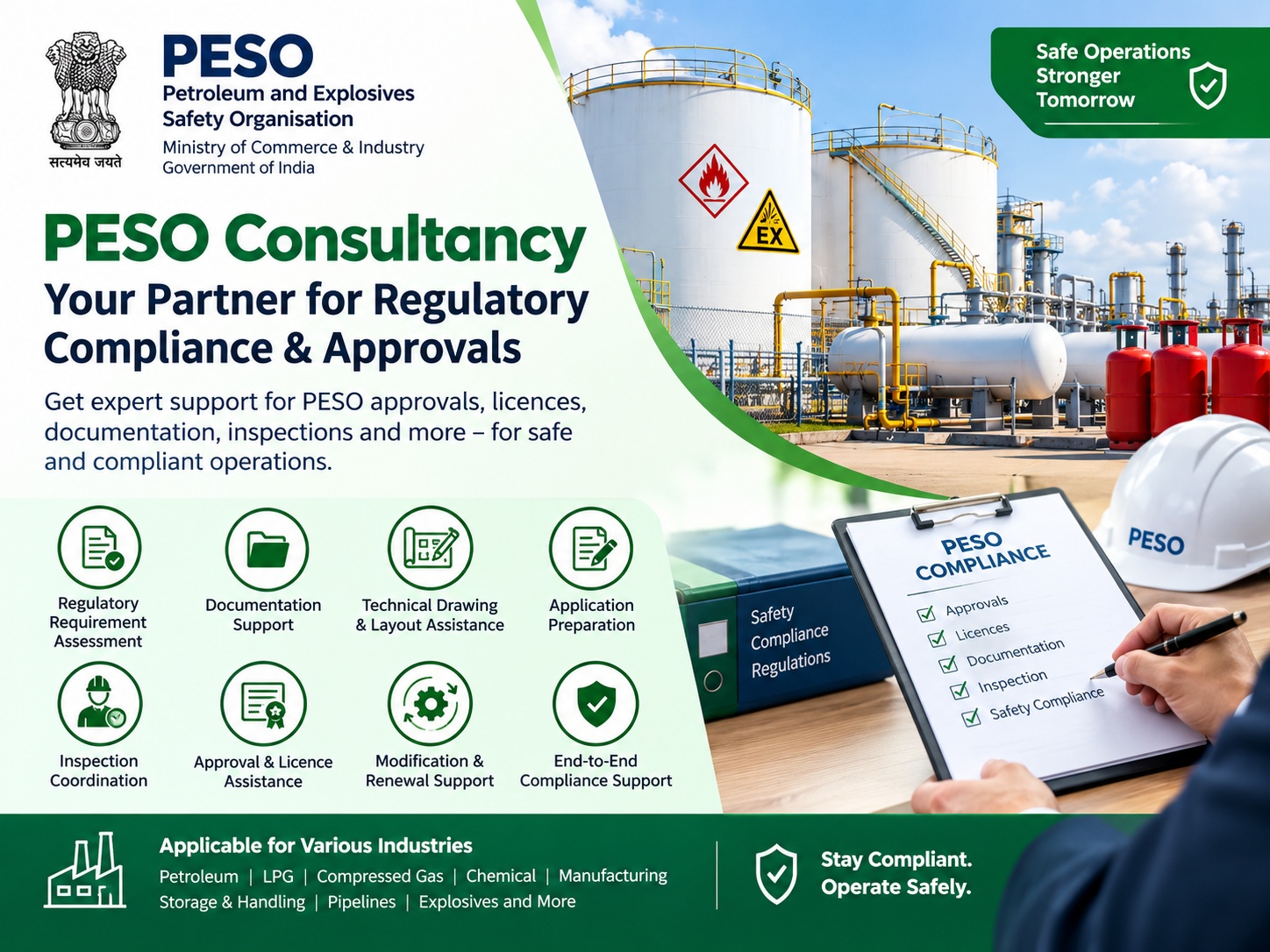
PESO Consultancy
PESO Consultancy plays an important role for businesses involved in the manufacturing, storage, transportation, installation, and handling of petroleum products, compressed gases, and other hazardous substances. In India, several activities involving petroleum and explosive substances are regulated to ensure safe operations, proper storage, and compliance with applicable legal requirements.
The Petroleum and Explosives Safety Organisation (PESO) operates under the Department for Promotion of Industry and Internal Trade (DPIIT), Ministry of Commerce and Industry, Government of India. Businesses that fall under PESO regulations may need approvals, licences, authorisations, or certifications before starting or expanding their operations.
A professional PESO Consultancy can help businesses understand applicable requirements, prepare technical documentation, coordinate applications, and manage the compliance process.
What is PESO Consultancy?
PESO Consultancy refers to professional assistance provided to companies for obtaining applicable approvals, licences, and permissions under regulations administered by PESO.
Depending on the nature of the business, requirements may involve petroleum storage facilities, LPG installations, compressed gas systems, pressure vessels, filling stations, petroleum pipelines, explosive-related activities, and other regulated installations.
A PESO consultant generally helps clients understand the applicable rules and technical requirements and supports them throughout the documentation and application process.
Why is PESO Compliance Important?
PESO compliance is important for businesses handling regulated petroleum, petroleum products, compressed gases, and explosives because these materials can present significant fire, explosion, and operational safety risks when improperly stored or handled.
Compliance helps businesses:
Understand applicable statutory requirements
Obtain necessary approvals and licences
Maintain required technical documentation
Ensure installations meet prescribed safety requirements
Support safe storage and handling practices
Reduce compliance-related delays
Prepare documentation for inspections
Maintain regulatory records
Support expansion or modification of regulated facilities
Businesses should identify their specific regulatory requirements before establishing or modifying an installation.
Who May Need PESO Consultancy?
PESO-related compliance can apply to different industries and business activities. The exact requirements depend on the substance, quantity, installation design, storage method, equipment, and intended use.
Businesses that may require PESO-related assistance include:
Petroleum storage facilities
LPG storage and handling facilities
Petroleum dispensing stations
Industrial gas installations
Compressed gas storage facilities
Gas cylinder filling and handling facilities
Pressure vessel installations
Petroleum pipelines
Chemical and process industries
Manufacturing units handling hazardous substances
Warehouses and storage facilities
Fuel-related infrastructure projects
Organisations involved in regulated explosive activities
A professional consultant can review the proposed activity and help determine which approvals may be applicable.
Major Services Covered Under PESO Consultancy
A comprehensive PESO Consultancy service may cover different stages of the approval and compliance process.
1. Regulatory Requirement Assessment
The first step is understanding the client's business activity and identifying applicable PESO requirements. The consultant may review the type of material, storage capacity, equipment, location, facility layout, and proposed operations.
This assessment helps establish the regulatory pathway for the project.
2. Documentation Support
Proper documentation is an important part of regulatory applications. Depending on the project, documents may include technical drawings, site plans, equipment details, safety information, ownership or lease documents, and other supporting records.
A consultant can help organise the required documentation according to the applicable requirements.
3. Technical Drawing and Layout Assistance
Certain regulated installations require technical layouts and drawings showing storage arrangements, equipment positions, safety distances, pipelines, access areas, and other relevant details.
PESO consultants can coordinate the preparation or review of technical documents so that they are aligned with applicable requirements.
4. Application Preparation
Submitting an application with incomplete or inconsistent information can cause delays. PESO Consultancy services can include assistance with preparing application forms, compiling supporting documents, and checking information before submission.
5. Inspection Coordination
Some approvals and licences may involve inspection or verification of the proposed installation. Consultants can assist businesses in preparing for inspections by reviewing documentation, site arrangements, and applicable safety requirements.
6. Approval and Licence Assistance
Depending on the activity, PESO may regulate different types of approvals and licences. A consultant can help identify the relevant category and coordinate the application process with the concerned authorities.
7. Modification and Renewal Support
Businesses may need regulatory assistance when modifying an existing installation, increasing capacity, changing equipment, or renewing applicable permissions.
Consultants can help evaluate the proposed changes and identify the documentation or approval requirements.
PESO Approval Process
The exact procedure depends on the nature of the project. However, a typical consultancy process may include the following steps:
Step 1 – Initial Requirement Assessment:
The consultant reviews the business activity, products, storage capacity, equipment, and facility details.
Step 2 – Regulatory Identification:
Applicable PESO rules, approvals, licences, and technical requirements are identified.
Step 3 – Documentation Preparation:
Required forms, drawings, technical documents, and supporting records are compiled.
Step 4 – Application Submission:
The application is prepared and submitted through the applicable regulatory process.
Step 5 – Inspection/Clarification:
If required, the consultant assists with inspection preparation and responses to regulatory observations.
Step 6 – Compliance Resolution:
Any identified gaps or additional requirements are addressed through appropriate documentation or corrective measures.
Step 7 – Approval/Licence:
After the applicable regulatory process is completed, the relevant approval or licence may be issued by the competent authority.
The timeline and requirements can vary depending on the project and the applicable regulatory category.
Benefits of Hiring a PESO Consultant
Working with an experienced PESO consultant can simplify the compliance process for businesses.
Key benefits include:
Professional regulatory guidance
Better understanding of applicable requirements
Organised documentation
Technical coordination
Assistance with application procedures
Support during inspections
Assistance in resolving documentation gaps
Support for renewals and modifications
Reduced administrative burden
However, businesses should independently verify the applicable statutory requirements and ensure that their facilities meet all relevant safety obligations.
How to Choose a PESO Consultancy
Businesses should consider several factors before appointing a consultant. Relevant factors include experience with similar projects, understanding of applicable regulations, technical capabilities, documentation expertise, communication, and experience in coordinating regulatory processes.
It is also useful to clearly define the scope of consultancy services before engagement. The scope may include documentation, technical drawings, application filing, inspection coordination, follow-up, renewal support, or modification assistance.
PESO Consultancy for Different Industries
PESO-related requirements can affect a wide range of industries. Manufacturing companies may require assistance for hazardous material storage or industrial gas systems. Petroleum businesses may need support for petroleum storage and dispensing infrastructure. Chemical industries may require regulatory guidance for specific installations.
Similarly, companies dealing with compressed gases, cylinders, pressure vessels, or other regulated equipment may require professional assistance to understand their compliance obligations.
Importance of Technical and Safety Compliance
PESO compliance is not simply an administrative process. The underlying objective is to promote safe handling, storage, transportation, and use of regulated substances and equipment.
Businesses should therefore treat regulatory compliance as part of their overall safety management system. Proper facility design, equipment selection, installation practices, operational controls, documentation, and periodic review can contribute to safer operations.
Conclusion
PESO Consultancy provides businesses with professional support for navigating regulatory requirements related to petroleum, compressed gases, explosives, and other regulated activities. From requirement assessment and documentation to application preparation, inspection coordination, and licence-related support, consultants can help businesses manage the regulatory process more systematically.
Before beginning a new project or modifying an existing installation, businesses should identify the applicable PESO requirements based on their specific activity and facility. Professional consultancy can help organise the process, but the responsibility for maintaining a safe and compliant installation remains with the business operator.
Choosing a consultant with relevant technical and regulatory experience can make the compliance process more structured and help businesses address documentation and procedural requirements efficiently.
Representative Client's