
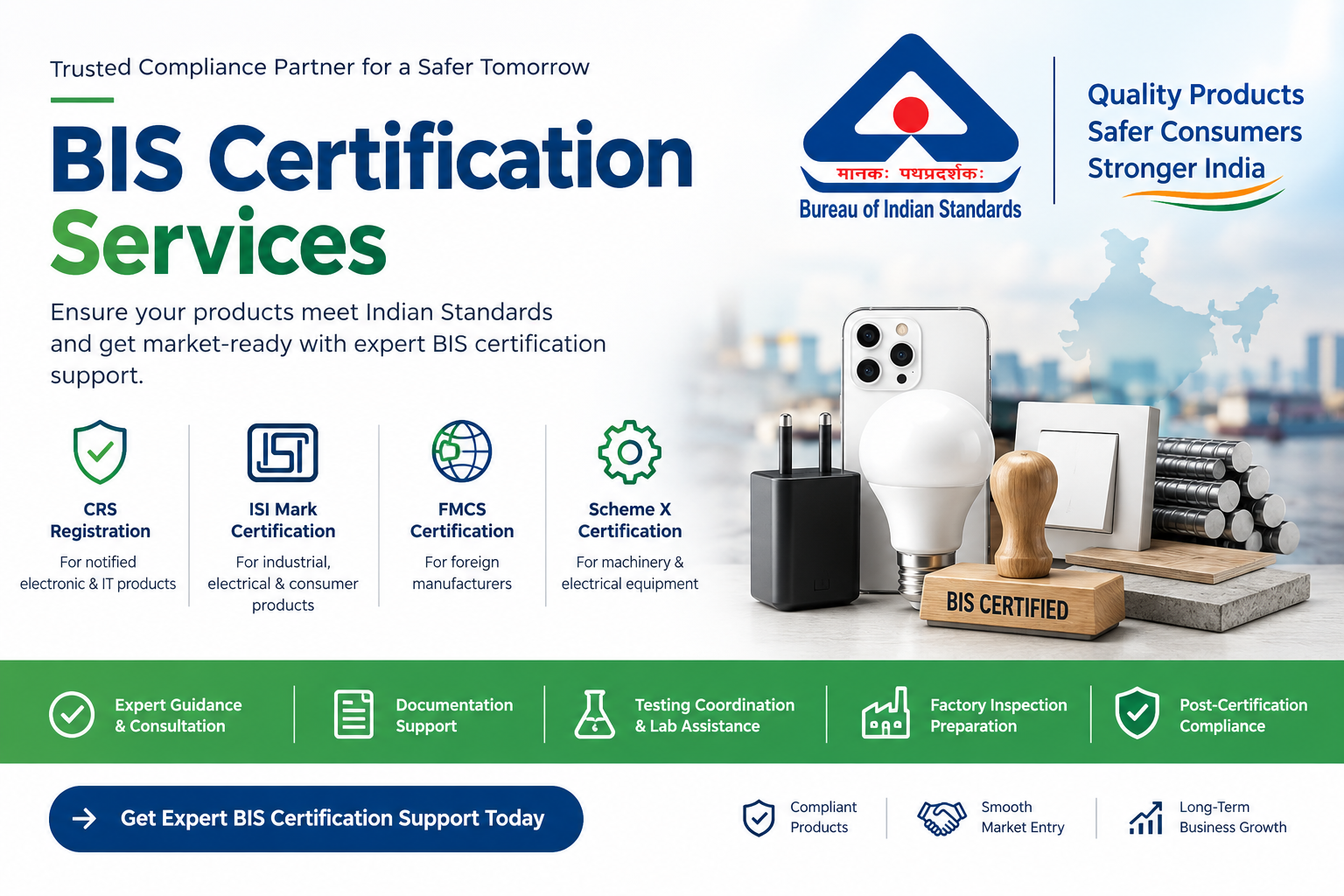
BIS Certification Services in India
BIS Certification Services play an important role in helping manufacturers, importers, and businesses comply with Indian product quality and safety requirements. The Bureau of Indian Standards (BIS) is India's national standards body, responsible for developing standards and operating product certification schemes to ensure that products meet applicable quality, safety, and performance requirements.
In India, BIS certification is mandatory for various products covered under applicable Quality Control Orders (QCOs) and other government notifications. Depending on the product and the applicable scheme, businesses may need a BIS licence, registration, or another form of regulatory approval before manufacturing, importing, distributing, or selling products in the Indian market.
Professional BIS Certification Services help businesses understand the applicable Indian Standards, identify certification requirements, coordinate product testing, prepare documentation, and navigate the application process. Working with an experienced BIS certification consultant can help reduce documentation errors and avoid unnecessary delays.
What Is BIS Certification?
BIS certification is a conformity assessment process through which a product is evaluated against the relevant Indian Standard under an applicable BIS scheme. It helps demonstrate that the product meets specified requirements relating to quality, safety, reliability, and performance.
Depending on the product category, certification may involve laboratory testing, factory inspection, quality control procedures, and assessment of manufacturing facilities. Certain products may be covered under the Compulsory Registration Scheme (CRS), while others may require an ISI Mark licence or certification under another applicable BIS scheme.
BIS certification requirements differ according to the product, the applicable standard, and the relevant government notification. Therefore, businesses should verify the latest requirements before applying.
Why Are BIS Certification Services Important?
Obtaining the appropriate BIS approval is essential for businesses dealing with regulated products in India. Professional BIS Certification Services can help manufacturers and importers understand their compliance obligations and prepare for the certification process.
Key benefits include:
Regulatory compliance: Helps businesses identify applicable Indian Standards and mandatory certification requirements.
Product quality assurance: Supports conformity with prescribed safety, performance, and quality parameters.
Market access: Helps businesses meet applicable regulatory conditions for selling covered products in India.
Documentation support: Assists in preparing applications, technical documents, and supporting records.
Testing coordination: Helps arrange product testing with an appropriate BIS-recognised laboratory, as required by the scheme.
Reduced application errors: Helps identify missing documents and inconsistencies before submission.
Import compliance: Helps importers and foreign manufacturers understand the applicable certification process before bringing regulated products into India.
Types of BIS Certification Services
Different products require different certification routes. The main services are explained below.
1. BIS ISI Mark Certification
ISI Mark certification is widely used for products covered under the BIS product certification scheme. It indicates that the product conforms to the relevant Indian Standard, subject to the applicable licence and marking requirements.
Products covered by mandatory certification orders may require a valid BIS licence before being manufactured or sold in India.
BIS ISI Mark Certification Services may include:
Identifying the applicable Indian Standard.
Reviewing product specifications and manufacturing processes.
Coordinating product testing.
Preparing application documentation.
Supporting factory inspection readiness.
Assisting with responses to BIS queries.
Helping businesses understand licence maintenance requirements.
2. BIS CRS Registration
The Compulsory Registration Scheme (CRS) applies to specified product categories notified by the government. It covers several electronic and information technology products, along with other notified categories.
Depending on the product, CRS registration generally involves testing at a recognised laboratory and submitting the required application and supporting documents through the applicable registration process.
BIS CRS Registration Services can assist manufacturers and importers with product classification, applicable Indian Standards, sample testing coordination, document preparation, and application follow-up.
3. BIS Scheme X Certification
BIS Scheme X is an important certification route for products covered by the applicable provisions and notifications, including certain machinery and electrical equipment.
The specific requirements depend on the product category and the relevant scheme provisions. Businesses should confirm whether Scheme X applies to their equipment before beginning the certification process.
Consultancy support may include applicability assessment, documentation preparation, testing coordination, manufacturing facility readiness, and application assistance.
4. BIS FMCS Certification
The Foreign Manufacturers Certification Scheme (FMCS) enables eligible foreign manufacturers to obtain BIS certification for applicable products manufactured outside India.
This scheme is relevant to overseas manufacturers intending to supply products covered by BIS certification requirements to the Indian market.
BIS FMCS consultancy services may help with identifying the applicable standard, preparing technical documentation, coordinating testing, understanding factory inspection requirements, and communicating with the relevant authorities.
5. BIS Product Certification Consultancy
General BIS product certification consultancy supports businesses across different product categories and certification routes. The scope of support depends on the applicable standard and the specific requirements of the certification scheme.
A consultant can help determine whether a product needs an ISI Mark licence, CRS registration, Scheme X certification, or another approval, where applicable.
Products That May Require BIS Certification
BIS certification applies to a wide range of products, depending on the applicable standards and government notifications.
Examples include:
Electrical appliances and equipment.
LED lights and lighting products.
Electronic and information technology products.
Mobile phone accessories and specified electronic components.
Toys and children's products covered by relevant orders.
Cement and construction materials.
Steel and iron products.
Furniture products covered by applicable Quality Control Orders.
Certain machinery and electrical equipment.
Batteries and other notified product categories.
Important: Not every product in these categories automatically requires the same certification. Businesses must check the precise product description, applicable Indian Standard, current QCO, exemptions, and effective dates.
BIS Certification Process in India
The BIS certification process varies by scheme, but it generally follows several important steps.
Step 1: Identify the Applicable Indian Standard
The first step is to determine which Indian Standard applies to the product. This requires reviewing the product's specifications, intended use, construction, and applicable government notifications.
Step 2: Check Mandatory Certification Requirements
Businesses should confirm whether certification is mandatory and identify the appropriate scheme. This helps avoid applying under the wrong certification route.
Step 3: Prepare the Required Documents
Documentation may include business registration records, manufacturing details, product specifications, test reports, factory information, authorised representative details, and other scheme-specific documents.
Foreign manufacturers may need additional documentation relating to their overseas manufacturing facility and authorised Indian representative, where applicable.
Step 4: Arrange Product Testing
Product samples may need to be tested by a BIS-recognised laboratory or another laboratory specifically permitted under the applicable scheme. The testing requirements depend on the relevant Indian Standard and certification route.
Step 5: Submit the Application
The application and supporting documents must be submitted through the applicable BIS process. The information provided should be accurate, complete, and consistent.
Step 6: Factory Inspection, Where Required
For certification schemes involving factory assessment, BIS may inspect the manufacturing premises and evaluate relevant production and quality control arrangements.
Step 7: Grant of Certification
BIS reviews the application, test results, inspection findings, and other applicable requirements. Certification is granted only when the prescribed conditions are fulfilled.
After approval, the licensee must follow the relevant marking, surveillance, renewal, and ongoing compliance requirements.
Documents Required for BIS Certification
The required documents vary according to the product and scheme. Common documents may include:
Company registration certificate or business incorporation documents.
Manufacturer's address and factory details.
Product technical specifications and photographs.
Brand or trademark ownership and authorisation documents, where applicable.
Manufacturing process details.
Quality control equipment and testing facility information.
Product test reports, where required.
Authorisation documents for an authorised representative, where applicable.
Undertakings, declarations, and other scheme-specific forms.
Preparing the correct documentation before applying can help minimise avoidable delays.
How to Choose the Right BIS Certification Consultant
Selecting an experienced BIS certification consultant can make the compliance process easier to manage. Businesses should look for a consultant who understands the relevant Indian Standards, certification schemes, laboratory testing requirements, and current regulatory notifications.
Before choosing a consultancy, consider its experience with your product category, transparency regarding professional fees, clarity about testing and government charges, and ability to provide support throughout the application process.
A reliable consultant should explain the applicable requirements clearly and should never guarantee certification without the required testing, assessment, and approval.
BIS Certification Services for Indian and Foreign Manufacturers
Indian manufacturers may need BIS certification to comply with mandatory product requirements before placing regulated products on the market. Foreign manufacturers may also need the appropriate approval before exporting covered products to India.
Professional consultancy support can help both groups understand applicable standards, prepare documentation, coordinate testing, and manage scheme-specific requirements.
Importers should also verify the certification status of the actual manufacturer and product. A certificate issued for one product, factory, or brand should not be assumed to cover every other product or manufacturing location.
Conclusion
BIS Certification Services help manufacturers, importers, and foreign businesses understand and manage product certification requirements in India. From ISI Mark certification and CRS registration to FMCS and Scheme X, the appropriate route depends on the product, the applicable Indian Standard, and current regulatory requirements.
By identifying the correct certification scheme, preparing accurate documentation, coordinating testing, and maintaining compliance after approval, businesses can improve their readiness for the Indian market. Working with a knowledgeable BIS certification consultant can make this process more organised and efficient while helping businesses avoid common application mistakes.
Frequently Asked Questions (FAQs)
1. What are BIS Certification Services?
BIS Certification Services help businesses identify applicable Indian Standards, prepare certification documents, coordinate product testing, submit applications, and manage relevant compliance requirements.
2. Is BIS certification mandatory in India?
BIS certification is mandatory for products covered by applicable government notifications and Quality Control Orders. Other products may have voluntary certification options. Requirements must be checked for each product.
3. How can I apply for BIS certification?
First, identify the applicable Indian Standard and certification scheme. Then prepare the required documents, arrange testing where required, submit the application, and complete any inspection or assessment required by BIS.
4. What is the difference between ISI Mark and CRS registration?
ISI Mark certification generally operates through the BIS product certification licensing framework, while CRS is a registration scheme for specified notified products. Their procedures and requirements differ.
5. How long does BIS certification take?
The timeline depends on the product category, testing duration, document completeness, inspection requirements, and BIS assessment. There is no single timeline applicable to every product.
6. What is the cost of BIS certification?
The cost varies by certification scheme and may include applicable government fees, laboratory testing charges, inspection-related expenses, and professional consultancy fees. A product-specific assessment is necessary to estimate the total cost.
7. Can foreign manufacturers obtain BIS certification?
Yes. Eligible foreign manufacturers can apply under the applicable BIS scheme, including FMCS where relevant. They must satisfy the requirements applicable to their product and manufacturing facility.
8. What documents are required for BIS certification?
Common documents include company registration records, product specifications, factory details, test reports where required, brand authorisation documents, and scheme-specific declarations.
9. Can a BIS consultant guarantee certification?
No consultant can legitimately guarantee approval regardless of compliance. Certification depends on fulfilling the applicable requirements and receiving approval from BIS.
10. Why should I hire a BIS certification consultant?
A consultant can help identify the correct scheme, organise documentation, coordinate testing, prepare for inspections where required, and manage application-related queries, reducing avoidable errors and delays.
Representative Client's