
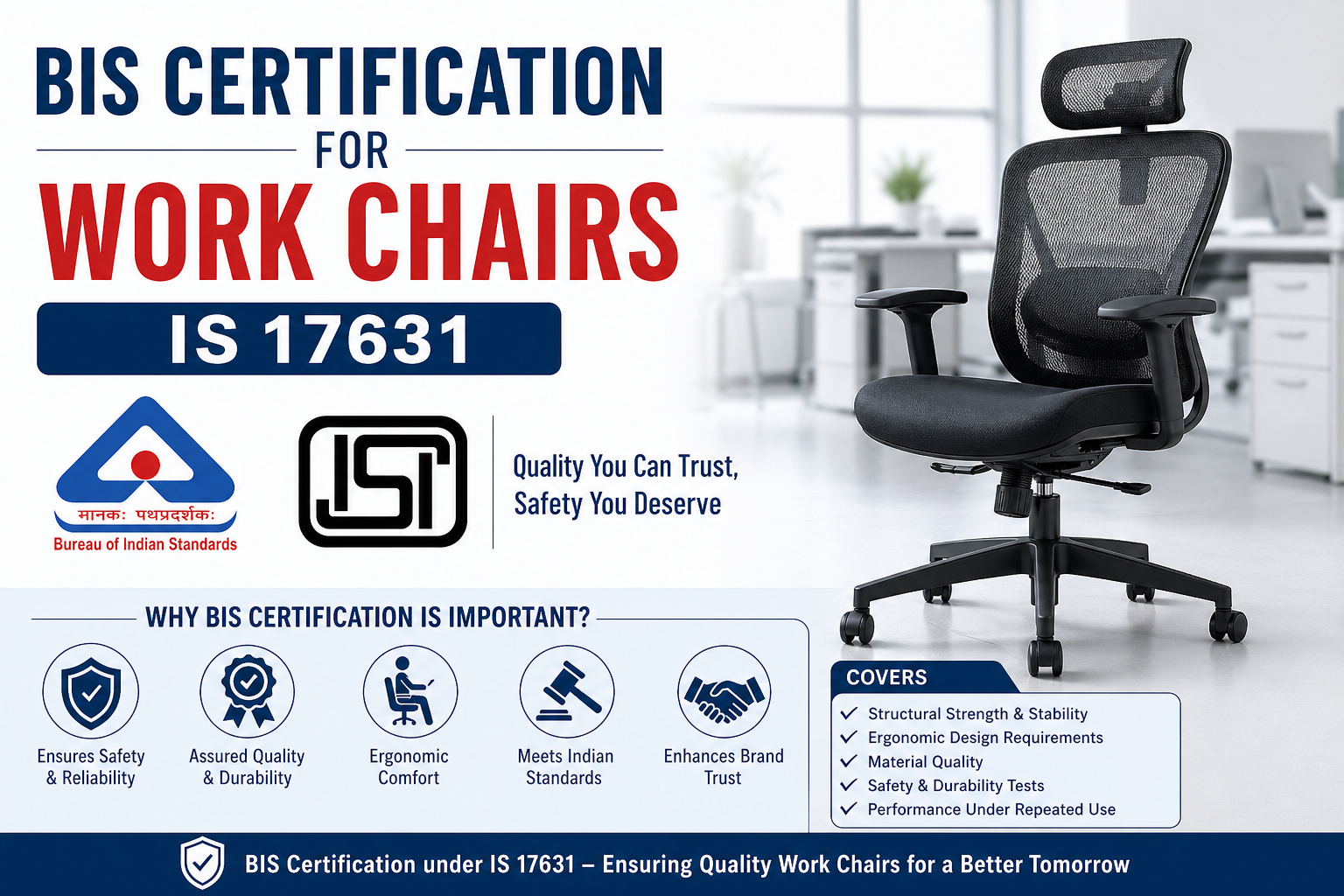
BIS Certification for Work Chairs – IS 17631
BIS certification for work chairs under IS 17631 has become an important requirement in India to ensure quality, safety, and durability in office and institutional furniture. With the increasing demand for ergonomic seating in workplaces, the Bureau of Indian Standards (BIS) has introduced this standard to regulate the manufacturing and sale of work chairs across the country.
What is IS 17631 for work chairs?
IS 17631 is an Indian Standard that specifies the requirements, test methods, and safety parameters for work chairs used in offices, commercial spaces, and similar environments. This standard ensures that chairs are designed to provide comfort, structural stability, and long-term usability. It covers various types of chairs, such as revolving chairs, adjustable chairs, and task chairs, used by employees for prolonged working hours.
The standard focuses on ergonomic design, strength, durability, and user safety. It also includes guidelines for materials, dimensions, load-bearing capacity, and performance under repeated use.
Why BIS Certification is Mandatory
The Government of India, through quality control initiatives, is making BIS certification mandatory for several furniture products, including work chairs. The objective is to eliminate substandard products from the market and protect consumers.
BIS certification under IS 17631 ensures:
Product safety and reliability
Standardised quality across manufacturers
Enhanced consumer trust
Compliance with government regulations
Reduced risk of product failure or injury
Manufacturers who fail to comply may face penalties, product bans, or legal action.
Key Requirements of IS 17631
To obtain BIS certification for work chairs, manufacturers must ensure their products meet the following criteria:
1. Structural Strength and Stability
Work chairs must pass various mechanical tests to ensure they can withstand daily usage, weight pressure, and movement without failure.
2. Ergonomic Design
The chair should support proper posture, including lumbar support, adjustable height, and comfortable seating angles.
3. Material Quality
High-quality raw materials must be used, including durable metals, plastics, and cushioning materials that do not degrade easily.
4. Safety Tests
Chairs are tested for sharp edges, tipping risks, and load-bearing capacity to prevent accidents.
5. Durability Testing
Repeated usage simulations are conducted to ensure the chair performs well over time.
BIS Certification Process
The BIS certification process for IS 17631 involves multiple steps:
1. Application Submission
Manufacturers must apply through the BIS portal with product details, manufacturing unit information, and required documentation.
2. Product Testing
Samples are tested in BIS-approved laboratories to verify compliance with IS 17631 standards.
3. Factory Inspection
BIS officials inspect the manufacturing facility to evaluate production processes, quality control systems, and infrastructure.
4. Grant of License
Once all requirements are met, BIS issues a certification license, allowing the manufacturer to use the ISI mark on their products.
5. Surveillance and Renewal
Regular inspections and audits are conducted to ensure continued compliance.
Documents Required
To apply for BIS certification, manufacturers typically need:
Company registration documents
Manufacturing process details
Product specifications and drawings
Test reports from approved labs
Quality control manuals
List of machinery and equipment
Benefits for Manufacturers
Obtaining BIS certification under IS 17631 provides several advantages:
Legal authorisation to sell in the Indian market
Increased brand credibility
Competitive advantage over non-certified products
Better acceptance in government and institutional tenders
Reduced product liability risks
Impact on Importers
Importers of work chairs must also comply with BIS regulations. Foreign manufacturers need to obtain certification under the BIS Foreign Manufacturers Certification Scheme (FMCS). Without this certification, imported chairs cannot be sold in India.
Conclusion
BIS certification for work chairs under IS 17631 is a crucial step toward ensuring quality, safety, and standardisation in the Indian furniture market. It benefits both consumers and manufacturers by promoting reliable and ergonomic products. As regulations become stricter, businesses must prioritise compliance to avoid legal issues and maintain their market presence.
If you are a manufacturer or importer of work chairs, obtaining BIS certification is not just a legal requirement—it is a strategic investment in quality and customer trust.
Representative Client's