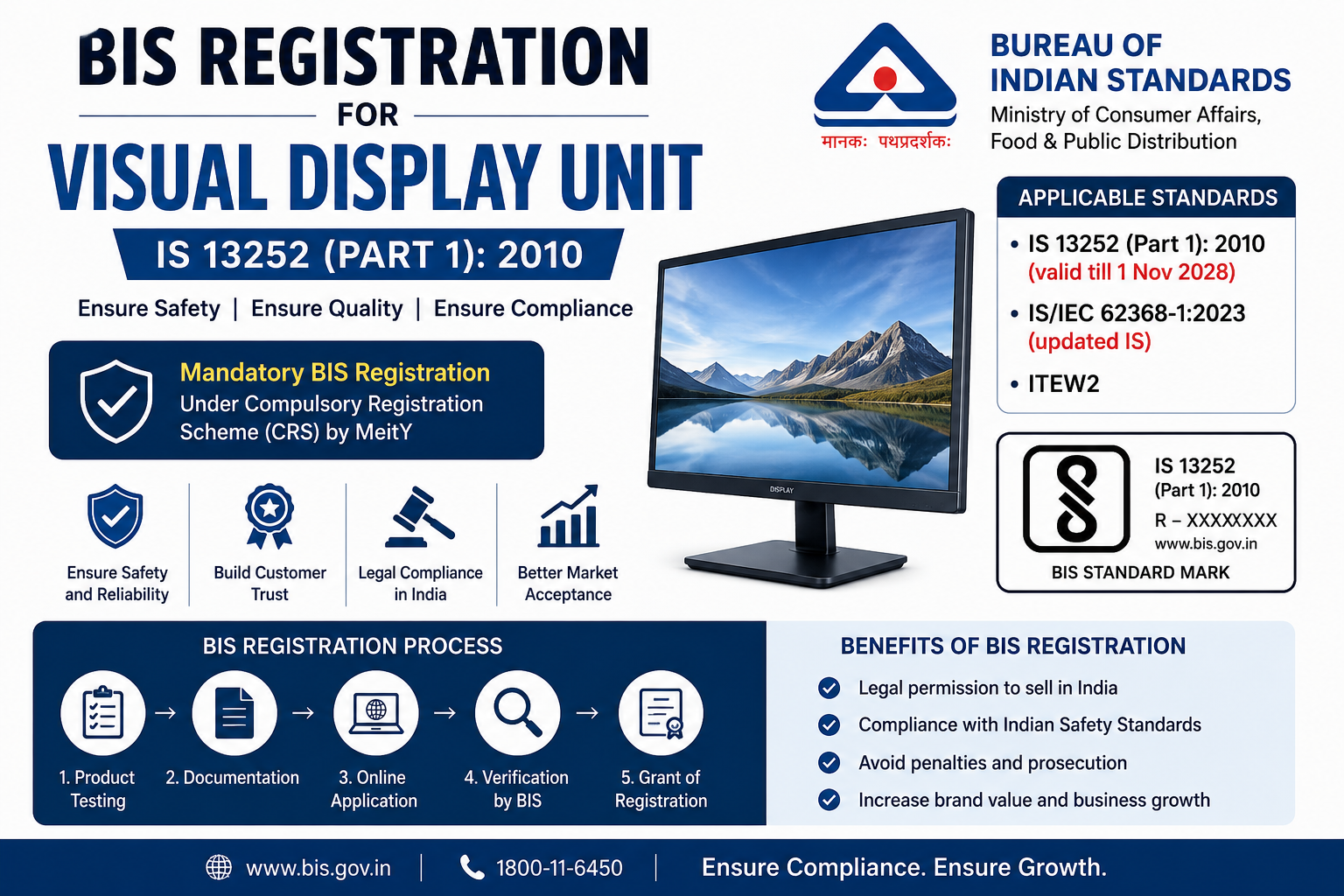
BIS Registration for Visual Display Unit – IS 13252
BIS Registration for Visual Display Unit – IS 13252
In today’s technology-driven world, Visual Display Units (VDUs) are widely used in offices, homes, industries, and educational institutions. These devices play an essential role in displaying visual information from computers, CCTV systems, industrial control systems, and various electronic applications. To ensure safety, quality, and compliance in the Indian market, manufacturers are required to obtain BIS Registration for Visual Display Units under the Compulsory Registration Scheme (CRS).
The Bureau of Indian Standards (BIS), under the Ministry of Electronics and Information Technology (MeitY), regulates the registration of electronic products to ensure they meet Indian safety standards before being sold in India.
Visual Display Units fall under mandatory BIS registration requirements and must comply with the applicable Indian Standard.
Applicable Standards: IS 13252 (Part 1): 2010 (valid till 1 Nov 2028), IS/IEC 62368-1:2023 (updated IS), ITEW2
This transition indicates that manufacturers need to prepare for migration from the older standard to the updated safety standard as per BIS and MeitY guidelines.
What is a Visual Display Unit?
A Visual Display Unit (VDU) is an electronic device used to display images, videos, graphics, and text information. These units are commonly used in:
Computer systems
Monitoring systems
Industrial equipment
Security surveillance systems
Office automation devices
Medical equipment
Examples include monitors, display panels, control room screens, and related electronic display devices.
Why is BIS Registration Required for Visual Display Units?
BIS Registration ensures that products sold in India meet the prescribed safety and quality requirements. It helps protect consumers from unsafe electrical products and improves product reliability.
Key benefits of BIS registration include:
Legal permission to sell products in India
Increased customer trust
Compliance with government regulations
Improved market acceptance
Protection against product rejection or penalties
Without BIS registration, manufacturers cannot legally import, manufacture, distribute, or sell Visual Display Units in India.
Who Needs BIS Registration?
The following entities need BIS registration for Visual Display Units:
Indian manufacturers
Foreign manufacturers
Importers (through manufacturer compliance)
Brand owners selling under private labeling
It is important to note that BIS registration is granted to the manufacturer, not directly to traders or distributors.
BIS Registration Process for Visual Display Units
The BIS CRS registration process involves multiple steps and requires proper documentation and testing.
1. Product Testing
The product must be tested in a BIS-recognized laboratory to ensure compliance with the applicable standard.
Testing includes safety parameters such as:
Electrical safety
Insulation resistance
Temperature rise
Protection against electric shock
Fire hazard protection
2. Documentation Preparation
Manufacturers must prepare all required documents before filing the application.
Common documents include:
Business license
Factory registration documents
Product specifications
Brand authorization letter
Test report
Trademark certificate
Authorized Indian Representative (for foreign manufacturers)
3. Application Submission
The application is submitted online through the BIS portal along with required documents and test reports.
4. Verification by BIS
BIS reviews the application and verifies all submitted details.
5. Grant of Registration
Once approved, BIS issues the registration certificate allowing the manufacturer to use the Standard Mark.
BIS Marking Requirements
After obtaining registration, manufacturers must place the BIS Standard Mark on the product, packaging, or label.
The marking generally includes:
BIS Standard Mark
Registration Number
Applicable Standard
This mark indicates that the product complies with Indian safety standards.
Challenges in BIS Registration
Many manufacturers face challenges during BIS registration, including:
Incorrect product classification
Testing delays
Documentation errors
Non-compliance with standards
Delays in approval
Professional consultancy support can simplify the registration process and reduce approval time.
Transition to Updated Standard
BIS has introduced migration from older safety standards to updated harmonized standards for electronic products. Manufacturers dealing with Visual Display Units should prepare for compliance under the latest standards.
The migration from IS 13252 (Part 1): 2010 to IS/IEC 62368-1:2023 represents a major regulatory shift focusing on hazard-based safety engineering.
Manufacturers should ensure early compliance to avoid disruptions in manufacturing, imports, or product sales.
Why Choose Professional BIS Consultancy?
BIS certification can be complex, especially for manufacturers unfamiliar with technical regulations and compliance requirements. Working with experienced consultants helps ensure smooth and hassle-free certification.
A professional BIS consultant can assist with:
Product classification
Documentation support
Testing coordination
Application filing
Compliance management
Approval follow-up
This reduces the risk of rejection and speeds up certification.
Conclusion
BIS Registration for Visual Display Units is mandatory for manufacturers and importers who want to sell compliant products in India. It ensures product safety, builds consumer trust, and helps businesses operate legally in the Indian market.
With updated compliance requirements under IS/IEC 62368-1:2023, businesses must stay prepared for standard migration and regulatory changes. Timely registration and compliance can help manufacturers avoid delays, penalties, and market disruptions.
If you are planning to manufacture, import, or sell Visual Display Units in India, obtaining BIS registration is a critical step toward business success and regulatory compliance.